
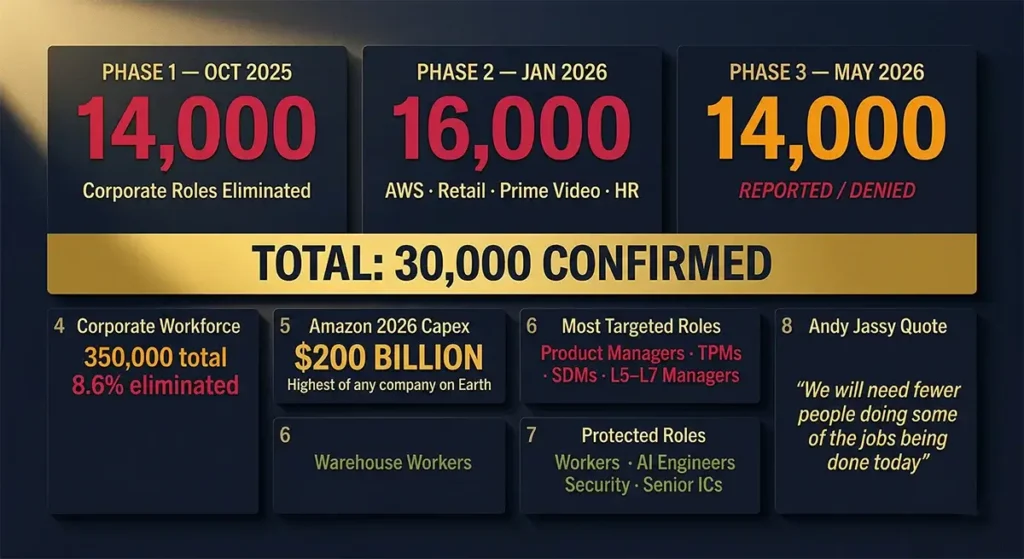
Amazon has executed one of the most consequential corporate workforce transformations in modern business history — and the process is not over. Between October 2025 and the spring of 2026, the company eliminated approximately 30,000 corporate positions across three rolling phases: 14,000 roles in October 2025, 16,000 in January 2026, and now — according to multiple reports citing Asia Business Outlook and internal company sources — a further 14,000 corporate jobs reportedly targeted for elimination as early as May 2026. Amazon has formally denied the May report, with a spokesperson stating “these reports are false and not based on fact.” But the pattern is undeniable, the structural logic is documented, and the question of whether this is over — or whether Amazon’s 350,000-person corporate workforce faces continued contraction — is the most important question in the technology labor market right now.
This cornerstone analysis cuts through the competing narratives — Andy Jassy’s “it’s culture” framing, the AI displacement argument, the capital reallocation thesis — to examine every root cause, every affected division, every legal right available to impacted employees, and what Amazon’s workforce transformation means for the broader tech employment landscape in 2026.
Amazon’s 30,000+ layoff cycle is best understood not as a single event but as a deliberate, phased restructuring driven simultaneously by four converging forces: (1) a genuine need to unwind pandemic-era overhiring that doubled the corporate workforce in three years, (2) a capital reallocation imperative to fund $200 billion in 2026 AI and data center investment by converting payroll expense into compute capacity, (3) a structural de-layering philosophy to flatten management hierarchies and increase individual contributor ownership, and (4) the displacement of coordination and oversight roles by AI agent systems that can manage project tracking, code review, and workflow orchestration without human managers. Andy Jassy’s “it’s culture” explanation is technically accurate — and strategically incomplete.
The Full Timeline: Amazon’s Three-Phase Workforce Reduction
To understand the current situation accurately, the full sequence of Amazon’s workforce reduction must be established, because the 14,000-employee figure has appeared at multiple points in the timeline with different meanings.
Phase 1 — October 2025: The First 14,000: Amazon announced its first major wave of the current restructuring cycle in October 2025, eliminating approximately 14,000 corporate positions. At the time, CEO Andy Jassy framed the cuts as the largest since 2023’s 27,000-job reduction and characterized them as the beginning — not the end — of an organizational overhaul. In an October memo, he stated the company had been “working to strengthen our organization by reducing layers, increasing ownership, and removing bureaucracy,” and explicitly signaled that other teams had not yet completed their organizational reviews. The October cuts primarily targeted product managers, technical program managers, and software development managers — roles that Jassy identified as creating coordination overhead without direct customer-facing impact. The 14,000 eliminated represented approximately 4% of Amazon’s approximately 350,000-person corporate workforce.
Phase 2 — January 2026: 16,000 More: On January 28, 2026, Amazon’s official blog published a message from Andy Jassy confirming that “approximately 16,000 roles across Amazon” would be eliminated — the second phase of the restructuring that the October announcement had foreshadowed. The company offered US-based affected employees 90 days to search for a new role internally, with international timing varying by local employment law requirements. The January cuts spanned Amazon Web Services (AWS), Retail, Prime Video, and People Experience and Technology (PXT) divisions. Beth Galetti, Amazon’s Senior VP of People Experience and Technology, described the layoffs as “reducing layers, increasing ownership, and removing bureaucracy” — language nearly identical to Jassy’s October framing. By the end of January 2026, Amazon had confirmed 30,000 corporate job losses in under four months — the largest workforce reduction in the company’s 31-year history by total count.
Phase 3 (Reported) — May 2026: Another 14,000?: Multiple reports surfaced in early April 2026 — citing Asia Business Outlook, TechNode, and internal sources on professional forums including Blind — indicating a potential third phase targeting approximately 14,000 additional corporate employees, predominantly at L5–L7 levels (mid-to-senior management), across AWS, Retail, and Human Resources divisions. Reports indicate the China operations may face particularly deep restructuring, with possible team-level shutdowns in some business units. A controversial element of the reported third phase is the selection methodology: employees and analysts in China’s tech community have raised concerns that the process appears “random” — based on manager discretion rather than objective performance criteria — with limited channels for appeal. Amazon has denied these reports. However, given that the October 2025 announcement explicitly stated teams had not yet completed their organizational reviews, the structural logic for continued cuts remains active.
Root Cause 1 — Pandemic Overhiring: The Factory That Built Too Many Workers
The most numerically significant root cause of Amazon’s current layoff cycle is the one that Andy Jassy most openly acknowledges: the company hired at an extraordinary and ultimately unsustainable rate during the 2020–2022 pandemic period.
When COVID-19 arrived and global populations began purchasing everything from home, Amazon became one of the world’s most essential economic infrastructures overnight. E-commerce volumes that analysts had projected would take a decade to materialize arrived in 18 months. The company responded rationally by hiring at historic rates: its global workforce grew from approximately 798,000 employees in early 2020 to over 1.6 million by the end of 2022 — more than doubling in under three years. Corporate hiring paralleled the frontline expansion, with product, engineering, and management teams built to support a business that, by 2022, looked permanently larger and more complex than the pre-pandemic Amazon had been.
The problem that emerged as pandemic-era tailwinds normalized is structural. When a company doubles its headcount over three years, it does not simply hire twice as many people doing the same jobs. It builds organizational hierarchies to manage those people — managers of managers of managers, coordination layers, program management offices, and bureaucratic structures that generate internal meetings and approvals but do not necessarily generate customer value. Jassy described this dynamic explicitly on Amazon’s earnings call: “If you grow as fast as we did for several years, the size of businesses, the number of people, the number of locations, the types of businesses you’re in, you end up with a lot more people than what you had before, and you end up with a lot more layers. Sometimes without realizing it, you can weaken the ownership of the people that you have who are doing the actual work.”
The data makes the overhiring argument concrete: Amazon added 27,000 corporate jobs between 2019 and the peak hiring year, then shed 27,000 in its first major correction in 2022–2023, and is now eliminating another 30,000+ in 2025–2026. The net change from 2019 to 2026, even after all current cuts, still leaves Amazon with more corporate employees than it had before the pandemic — the company is not cutting to pre-pandemic levels but to a structurally rational staffing model given current business scale and AI-augmented operational capability.
Root Cause 2 — Capital Reallocation: Turning Salaries Into Silicon
Andy Jassy said the layoffs were “not really financially driven.” The balance sheet tells a more complicated story.
Amazon’s 2026 capital expenditure commitment is $200 billion — a number that landed well above every analyst estimate (FactSet consensus was $146.6 billion) when Jassy announced it alongside Q4 2025 earnings. The majority of this capital expenditure is directed at AI infrastructure: data centers, custom silicon (Trainium and Inferentia chips), networking equipment, and the enormous power and cooling infrastructure required to run AI training and inference workloads at the scale Amazon has committed to. Amazon has also invested $8 billion in Anthropic, committed $11 billion to Project Rainier (an advanced AI cluster), and is reportedly considering a $50 billion stake in OpenAI’s infrastructure buildout. Total AI-related commitments exceed $200 billion when these investments are aggregated.
Free cash flow mathematics makes the capital pressure visible. Amazon’s quarterly free cash flow went negative — approximately negative $4.8 billion — at precisely the moment its capital expenditure hit record levels. When a company’s cash flow turns negative while its investment commitments are at historic highs, the financial logic for reducing the highest-cost recurring expense — payroll — becomes immediate and compelling. A single L7 senior manager at Amazon’s Seattle headquarters earns approximately $250,000–$350,000 in total annual compensation including salary, bonus, and RSUs. Thirty thousand of those roles represent $7.5–$10.5 billion in annual compensation costs. The savings from the current restructuring are precisely the magnitude required to fund a meaningful portion of the AI infrastructure investment without increasing Amazon’s debt load proportionally.
One analyst described the dynamic precisely: “Amazon isn’t cutting 30,000 jobs because they have too many managers. They’re cutting 30,000 jobs because they need the money to buy GPUs. This isn’t a layoff. It’s a capital reallocation. Human headcount converted to compute capacity. Salaries transformed into silicon.” Whether one accepts this framing as the primary driver or as one factor among several, the financial arithmetic is undeniable: the payroll savings from 30,000 corporate eliminations directionally fund approximately one-third of Amazon’s 2026 AI capex above the analyst consensus baseline.
Root Cause 3 — The De-Layering Philosophy: Andy Jassy’s “Day 1” Mandate
Separate from — but intertwined with — the pandemic unwinding and capital reallocation pressures is a genuine philosophical conviction at Amazon’s leadership level about organizational structure. This is the root cause that Jassy most consistently emphasizes, and it has a longer history than either the pandemic overhiring or the AI investment thesis.
Amazon’s internal culture has always been oriented around Jeff Bezos’s “Day 1” philosophy — the idea that the company should perpetually operate with the urgency, ownership, and customer obsession of a startup on its first day, regardless of how large it becomes. “Day 2” — the comfortable, bureaucratic, slow-moving organization of a mature company — is explicitly described as the antechamber to decline in Amazon’s cultural canon. The problem that Jassy identified in 2024 and 2025 is that the pandemic hiring wave had inadvertently moved Amazon toward Day 2: more layers, more approvals, more meetings, more coordination overhead, less direct ownership at the individual contributor level.
In September 2024, Jassy published a memo requiring Amazon employees to return to office five days per week — a policy widely interpreted as designed partly to make remote workers self-select out and partly to restore the cultural intensity of in-person collaboration. That same memo included a directive to increase the ratio of individual contributors to managers by at least 15% by the first quarter of 2025. He also established a “no bureaucracy email alias” — an internal channel for employees to report bureaucratic obstacles — and set explicit targets for reducing the number of management layers in every Amazon organizational unit.
The October 2025 and January 2026 layoffs are the structural execution of this September 2024 directive. The manager-to-IC ratio, which had drifted toward approximately 1:6 in many Amazon organizations during the pandemic growth phase, is being targeted at 1:10 or higher — meaning that for every 10 individual contributors, Amazon now seeks one manager rather than 1.6. That ratio change, applied across 350,000 corporate employees, implies the elimination of tens of thousands of management-layer positions independent of any AI displacement argument. The math is simply the ratio multiplied by the organizational scale.
Root Cause 4 — AI Agent Displacement: The “Project Dawn” Factor
The most forward-looking and structurally significant root cause of Amazon’s corporate downsizing — and the one that has the greatest implications for the technology labor market broadly — is the genuine displacement of coordination and oversight roles by AI agent systems.
Amazon CEO Andy Jassy told investors as early as June 2025: “We will need fewer people doing some of the jobs that are being done today, and more people doing other types of jobs.” This admission — that AI would structurally reduce Amazon’s corporate headcount over the coming years — predates and contextualizes the October 2025 and January 2026 layoff announcements. What has emerged since then is evidence that the displacement is already operational, not merely projected.
Internal reports describe “Project Dawn” — a suite of AI agents capable of handling project management, logistics coordination, software quality assurance review, and workflow orchestration. These are precisely the functions performed by the product managers, technical program managers, and software development managers who have been most heavily targeted in both the October 2025 and January 2026 waves. Amazon Q, the company’s enterprise AI assistant, and proprietary internal coding assistants are reportedly handling project tracking and basic code review functions that previously required human managers — reducing the supervision ratio required and making many middle-management coordination roles redundant.
The “knowledge transfer sessions” described by former employees — in which departing staff were asked to document their decision-making processes and creative workflows, ostensibly for transition purposes — are reported to have fed into training datasets for AI agents. One former L7 senior manager described spending his final weeks “building detailed prompt architectures, only to realize his work enabled offshore teams to ship features significantly faster than his original domestic team ever could.” Whether this represents deliberate knowledge extraction for AI training or simply standard transition documentation is disputed — but the pattern has generated significant employee concern about the ethics of the process.
The tech layoff tracker maintained by Medha Cloud, analyzing 166 layoff events in 2026 to date, found that AI is a real catalyst for approximately 1 in 5 technology layoffs. For Amazon specifically, the correlation between the roles eliminated and the functions that AI agents now perform is too precise to be coincidental: the manager-to-IC ratio restructuring and the AI agent capability expansion are parallel processes that reinforce each other. Fewer human managers are needed because AI agents are performing more managerial coordination functions — and AI agents can perform more coordination functions because the documentation and process knowledge of departed managers has been incorporated into training data.
Who Is Being Cut: The Profile of Amazon’s Eliminated Roles
Understanding which specific roles are being eliminated — and which are being protected — is essential for current Amazon employees assessing their vulnerability and for broader technology workers evaluating their own career positioning.
Most targeted categories (highest elimination risk):
Product managers (PMs) and technical program managers (TPMs) are the single most consistently targeted category across all three phases of Amazon’s restructuring. These roles sit at the intersection of customer requirements, engineering capacity, and business objectives — traditionally requiring deep coordination between multiple teams. AI tools are increasingly performing the scheduling, tracking, documentation, and cross-team communication functions that defined PM and TPM value, reducing the headcount required per engineering team. Amazon’s ratio restructuring implies the elimination of approximately one PM or TPM for every six that existed at the pandemic-era peak organizational structure.
Software development managers (SDMs) and engineering managers below the L8 (Senior Manager) and L10 (Director) levels are similarly targeted. The manager-to-IC ratio increase of 15%+ means that many L5 and L6 engineering managers who had four to six direct reports are being eliminated, with their reports either rolling up to a single L7 manager or operating with increased autonomy under AI-assisted coordination tools. L7 senior managers — who form the critical layer below Directors — are reportedly heavily represented in the May 2026 reported wave, reflecting Amazon’s push to make L7 a rarer, higher-caliber level rather than a career stage that a large percentage of senior employees occupy.
Human Resources generalist roles, particularly those involved in recruiting coordination, onboarding administration, and routine employee relations, are being consolidated as Amazon’s hiring pace slows and HR technology handles routine case management. The People Experience and Technology division — Amazon’s HR organization — was explicitly mentioned in the January 2026 confirmed layoff announcement.
Protected categories (lowest elimination risk):
Frontline warehouse and logistics workers — Amazon’s approximately 1.2 million non-corporate employees — are explicitly not part of the current restructuring. Amazon has simultaneously announced over $1 billion in compensation increases for US fulfillment and transportation employees, reinforcing that the current reduction is targeted exclusively at the white-collar corporate layer.
AI and machine learning engineers, data architects, and security professionals are actively being hired to replace the eliminated coordination roles. The net employment picture at Amazon involves a significant skill-mix rebalancing: coordination and management positions are being reduced while technical AI capability positions are being expanded. This creates a bifurcated outcome in which total corporate headcount falls even as hiring in specific technical categories remains strong.
Senior engineers (L6+ individual contributors) with deep technical specialization in AWS infrastructure, robotics, semiconductor design, and satellite technology are similarly protected — these are the “individual contributor” roles that Amazon’s de-layering philosophy is explicitly designed to empower by removing management overhead above them.
The “Random Selection” Controversy: How Amazon Is Choosing Who to Cut
One of the most inflammatory aspects of the reported May 2026 phase is the selection methodology concern raised by employees and analysts in China’s tech community, but echoed in posts on Blind from US-based employees as well. The concern: that the layoff selection process is not grounded in objective performance criteria but in discretionary manager judgment that can appear arbitrary — or even genuinely random — to affected employees.
Unlike a plant closure or division shutdown where the rationale is geographic or organizational and the selection criterion is simply membership in the affected unit, Amazon’s corporate restructuring requires individual-level decisions about which employees to retain and which to release within teams that are being reduced rather than eliminated. When a team of eight reduces to five, someone must choose which three to cut — and the transparency of those criteria, the availability of appeal mechanisms, and the consistency of standards across thousands of such decisions across a company of Amazon’s scale are inherently difficult to guarantee.
The perception of arbitrariness is amplified by the fact that Amazon’s performance management system — its annual performance review and PIPs (Performance Improvement Plans) — is a separate, ongoing process from the layoff cycle. Employees who have received strong performance reviews and ratings find themselves included in layoffs because their role is being eliminated rather than their performance being found deficient. This conflation of role elimination (a business decision about organizational structure) with individual performance has generated significant morale damage and legal concern among affected employees.
Employment attorneys note that the distinction between performance-based termination and layoff matters significantly for severance, unemployment insurance eligibility, and potential legal claims. A layoff — where the role is eliminated — carries different legal implications than a performance termination, and employees should ensure their separation documentation accurately reflects the layoff nature of their termination rather than any performance-based characterization.
Financial Rights and Immediate Actions for Affected Amazon Employees
For the estimated 14,000–30,000 Amazon corporate employees affected by the confirmed and reported phases of this restructuring, several urgent legal, financial, and career actions are appropriate immediately upon notification.
Do not sign the severance agreement immediately: Amazon offers severance contingent on signing a separation agreement that typically includes non-disparagement clauses, non-solicitation provisions, and a general release of legal claims. US employees over 40 have at least 21 days to review the agreement (45 days if part of a group reduction program under the Older Workers Benefit Protection Act). Do not sign under pressure of same-day notification. Have an employment attorney review the agreement — particularly the non-compete and non-solicitation language, which varies by state and which California, for example, largely prohibits enforcement of. The standard severance Amazon has offered — reportedly four weeks of pay per year of service with a minimum floor — can sometimes be negotiated upward, particularly for senior employees or those with specialized leverage.
WARN Act notification rights: The federal Worker Adjustment and Retraining Notification Act requires employers with 100+ employees to provide 60 days’ advance written notice before mass layoffs affecting 50+ employees at a single location. Amazon’s phased approach — breaking the cuts into waves separated by weeks or months — may affect WARN Act applicability at specific locations. If Amazon provided fewer than 60 days’ notice for qualifying layoff events at your specific location, you may be entitled to 60 days of back pay and benefits. Employment attorneys who specialize in WARN Act class actions often work on contingency, meaning you pay only from any recovery rather than upfront.
File for unemployment benefits on day one: Do not wait. Unemployment insurance eligibility begins from the week you file, not the week you were terminated. Every day of delay forfeits potential benefit days. Amazon’s layoffs are unambiguously layoffs — not performance terminations — which means you are immediately eligible for unemployment insurance in your state. File at your state’s unemployment agency website the same day you receive your termination notification.
Equity and RSU treatment: Amazon’s RSU vesting schedule means that employees terminated between vesting dates forfeit unvested shares. Document your specific vesting schedule, upcoming vest dates, and the exact effective date of your termination to understand what you are forfeiting and what you have already vested. Shares vested before your termination date are yours; unvested shares are typically forfeited upon termination under standard RSU plan terms.
Internal transfer window: Amazon’s January 2026 announcement offered most US-based employees 90 days to search for a new role internally before their termination became effective. If you are in this window, the internal job board (internally accessible during the 90-day period) contains real opportunities and the success rate of internal transfers has historically been meaningful — particularly for employees willing to switch between divisions or geographic locations. Prioritize internal transfer exploration in the first 30 days of the notice period, as positions fill quickly and hiring managers may have informal information about which roles are actually open versus posted as a formality.
The Broader Tech Layoff Context: Amazon Is Not Alone
Amazon’s restructuring is the largest single event in the 2026 technology workforce contraction, but it is part of a sector-wide pattern that the Medha Cloud tech layoff tracker has documented across 166 separate events in 2026, affecting a total of 55,775 technology workers as of the tracker’s most recent update. The pattern across the sector shows consistent targeting of the same role categories that Amazon is prioritizing: middle managers, product and program managers, and coordination-heavy white-collar positions.
The sector-wide shift is from a hiring model that emphasized management hierarchy and headcount growth (appropriate for a period of rapid scaling) to a model that emphasizes individual contributor density and AI-augmented productivity (appropriate for a period of financial discipline and AI capability deployment). Companies including Salesforce, Target, Paramount, and dozens of others have participated in the same cycle, though at smaller scale than Amazon.
Amazon CEO Andy Jassy’s June 2025 prediction — that “we will need fewer people doing some of the jobs that are being done today” — is proving structurally accurate faster than many analysts anticipated. The question is not whether AI will reduce corporate headcount requirements in technology companies. It is whether the transition will be managed with the transparency, legal compliance, and human dignity that the scale of the impact demands. For the estimated 14,000 employees in Amazon’s reported May 2026 phase — as for the 30,000 already confirmed — the answer to that question matters more than any earnings multiple or capex commitment.


💬 0 Comments