
Inflation has eroded the purchasing power of American savings for the past three years — and in 2026, with tariff-driven inflation keeping consumer prices elevated even as the Federal Reserve considers rate cuts, protecting your savings from inflation is a genuinely important financial task. This guide explains every inflation-protection strategy available to individual Americans in 2026, from the simplest (I Bonds from the US Treasury) to the more sophisticated (commodity ETFs and TIPS), with an honest assessment of the tradeoffs of each.
The best inflation protection is a diversified combination of strategies — not a single “inflation hedge” — because different assets provide protection against different inflation drivers. Treasury I Bonds and TIPS provide direct, guaranteed protection against measured CPI inflation. Real estate, commodities, and inflation-protected dividend stocks provide additional hedges against cost-of-living increases that outpace the official CPI. No single strategy is optimal in all inflation environments.
Understanding What Inflation Actually Threatens
Before choosing inflation protection strategies, it helps to be precise about what inflation actually threatens. Inflation has three distinct financial effects: it erodes the purchasing power of cash holdings (money in checking and savings accounts earning below the inflation rate loses real value); it reduces the real return of fixed-income investments (a bond paying 3% yields a negative real return if inflation is 4%); and it raises the cost of future purchases — housing, healthcare, food, education, and other major expenditures that will be larger in nominal dollars than you currently anticipate.
The inflation protection strategies that matter most depend on which of these effects is most relevant to your situation. A pre-retiree with $500,000 in a money market account earning 4.5% in an environment with 3.5% inflation has a different problem than a young worker earning a 3% salary increase in a 4% inflation environment. Understanding your specific inflation exposure is the starting point for choosing appropriate protection.
Strategy 1: Treasury Inflation-Protected Securities (TIPS)
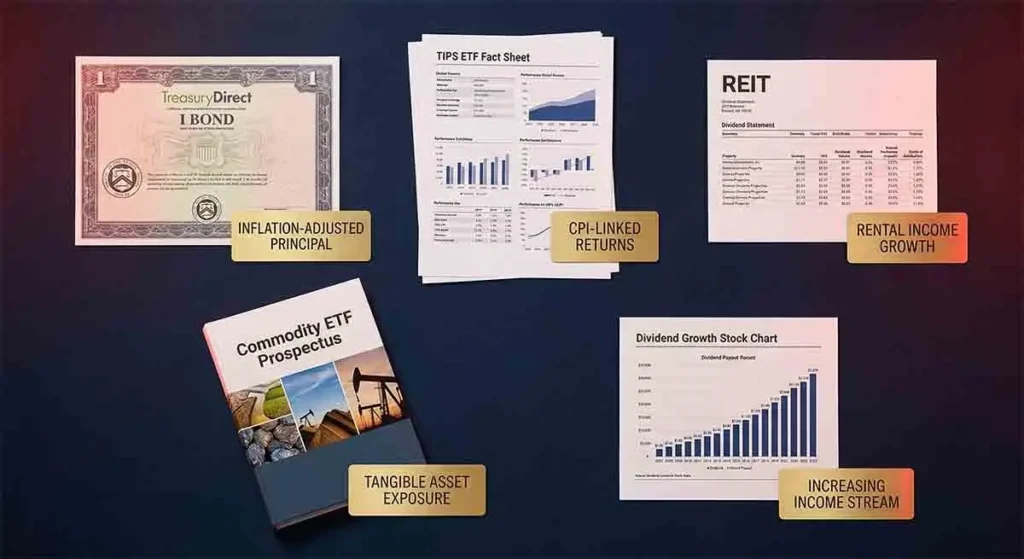
TIPS are US government bonds whose principal value adjusts with the Consumer Price Index — if CPI rises 3%, the face value of your TIPS holding rises by 3%, and the interest payment (which is a fixed percentage of the adjusted principal) rises accordingly. At maturity, you receive the greater of the inflation-adjusted principal or the original principal — providing deflation protection as well.
How to buy: Directly from the US Treasury at TreasuryDirect.gov (minimum $100), or through TIPS ETFs at any brokerage. The two most widely used TIPS ETFs are: SCHP (Schwab U.S. TIPS ETF, 0.03% expense ratio) and VTIP (Vanguard Short-Term Inflation-Protected Securities ETF, 0.04% expense ratio). VTIP focuses on shorter-term TIPS (0–5 years) and has significantly lower interest rate sensitivity than longer-duration TIPS funds — making it the preferred choice for investors concerned about both inflation and interest rate risk simultaneously.
Tax consideration: TIPS held in taxable accounts are taxed on both their interest income and the inflation adjustment to principal (even though you do not receive the inflation adjustment in cash until maturity) — creating “phantom income.” TIPS are most tax-efficient held in tax-advantaged accounts (IRA, 401(k)).
Strategy 2: I Bonds from the US Treasury
Series I Savings Bonds (I Bonds) are perhaps the most straightforward inflation-protection tool available to individual investors. They pay an interest rate that combines a fixed rate set at purchase (currently 1.3% for bonds purchased in 2026) with a variable rate that adjusts every six months based on CPI-U. The combined rate adjusts automatically with inflation, providing direct purchasing power protection.
2026 I Bond key facts: Current composite rate approximately 3.1–3.5% (verify at TreasuryDirect.gov for current rate, which resets each May and November); $10,000 annual purchase limit per person per Social Security number ($20,000 for married couples filing jointly); can be purchased only at TreasuryDirect.gov; must be held at least 12 months before redemption; a 3-month interest penalty applies to bonds redeemed before 5 years.
I Bonds vs HYSA: When HYSA rates are higher than the current I Bond composite rate (as is the case in early 2026), a HYSA provides better immediate returns with more liquidity. I Bonds become most attractive when inflation spikes significantly above the HYSA rate — as occurred in 2022 when I Bonds paid 9.62% while HYSAs paid 0.5–1%. The $10,000/year purchase limit constrains I Bonds as a primary inflation protection tool but makes them an excellent complementary holding.
Strategy 3: Real Estate — Direct and REITs
Real estate is historically one of the most effective long-run inflation hedges, for a straightforward reason: the cost of building new homes (land, labor, materials) rises with inflation, supporting the value of existing homes. Additionally, rental income typically increases with inflation over time — landlords raise rents as their own costs rise and as the replacement cost of comparable housing increases.
The inflation-protection characteristics of real estate are most reliable for direct ownership of physical property with a fixed-rate mortgage — a combination that provides both a real asset that appreciates with inflation and a debt obligation that becomes easier to service in real terms as inflation runs (the nominal mortgage payment stays constant while the purchasing power of money declines). However, direct real estate ownership requires significant capital, creates illiquidity, and involves management responsibilities that are not appropriate for all investors.
Real Estate Investment Trusts (REITs) provide exposure to inflation-protected real estate income without direct property ownership. The REIT categories with the strongest inflation-protection characteristics in 2026: self-storage REITs (short-term leases allow rapid rent adjustment with inflation), apartment REITs with lease renewal rights, industrial logistics REITs with CPI-escalation clauses, and healthcare REITs with government reimbursement escalation.
Strategy 4: Commodity Exposure
Commodities — oil, natural gas, metals, agricultural products — are the raw inputs whose prices drive inflation. When inflation rises because commodity costs are rising, commodity investments benefit directly from the same price increases that are eroding the value of your other holdings. This makes commodities one of the few assets that can provide positive returns precisely during inflationary episodes.
In 2026’s tariff-driven inflation environment, the commodity/inflation correlation is more complex than in standard demand-pull inflation — tariffs raise prices for specific imported goods rather than across all commodity categories. However, a broad commodity allocation still provides meaningful inflation protection. Practical access options: DJP (iPath Bloomberg Commodity Index ETN), PDBC (Invesco Optimum Yield Diversified Commodity Strategy ETF, actively managed with no K-1 tax form), and COMT (iShares MSCI Global Agriculture Producers ETF for agricultural commodity exposure specifically).
Strategy 5: Inflation-Resistant Dividend Stocks
Companies with strong pricing power — the ability to raise prices with or above inflation without losing customers — provide equity-based inflation protection. The classic categories are consumer staples companies (Procter & Gamble, Coca-Cola, Colgate-Palmolive), which sell products with inelastic demand and strong brand value that supports pricing; utilities with rate structures that allow inflation pass-through; and energy companies that benefit directly from commodity price increases.
Dividend growth investing — specifically, companies with 10–25+ consecutive years of annual dividend increases — historically provides reliable long-term purchasing power protection because dividend growth over time tends to match or exceed inflation. The Dividend Aristocrats (S&P 500 companies with 25+ consecutive years of dividend increases) and Dividend Kings (50+ consecutive years) are the most commonly referenced universe for this strategy, accessible through ETFs like NOBL (ProShares S&P 500 Dividend Aristocrats ETF, 0.35% expense ratio).
Building Your Inflation Protection Portfolio
A practical inflation-protection allocation for a 40-year-old investor with $100,000 in savings (beyond their emergency fund and retirement accounts) might look like:
- 40% — Total market index fund (core equity position with inflation protection through ownership of real assets and earnings power)
- 20% — TIPS ETF (direct CPI-linked inflation protection)
- 15% — Real estate exposure via REIT ETF (inflation-resistant real asset income)
- 15% — Dividend growth equity ETF (pricing-power inflation protection)
- 10% — Broad commodity ETF (direct commodity inflation hedge)
This allocation does not abandon equity market growth for pure inflation protection — it tilts toward inflation-resistant assets while maintaining the long-term growth participation that is necessary for genuine wealth building over decades. Pure inflation-protection portfolios (100% TIPS, I Bonds, and commodities) sacrifice long-term growth for near-term purchasing power protection — a tradeoff that is only appropriate for money with very short time horizons.



💬 0 Comments