
Small businesses are disproportionately vulnerable to recessions — they have thinner cash reserves, less access to credit, and more concentrated customer bases than large corporations. Yet small businesses are also disproportionately capable of adapting, pivoting, and finding opportunities that large bureaucratic competitors cannot. The difference between the small businesses that survive recessions and those that do not is almost entirely determined by the decisions made in the 6–12 months before the recession deepens.
The small businesses that emerge from recessions strongest are not those that cut the deepest — they are those that cut strategically, maintained their cash reserves, protected their best customers and employees, and identified the specific recession-driven opportunities in their market while competitors panicked. Recession survival is as much about offense as defense.
Step 1: Build and Protect Your Cash Reserve
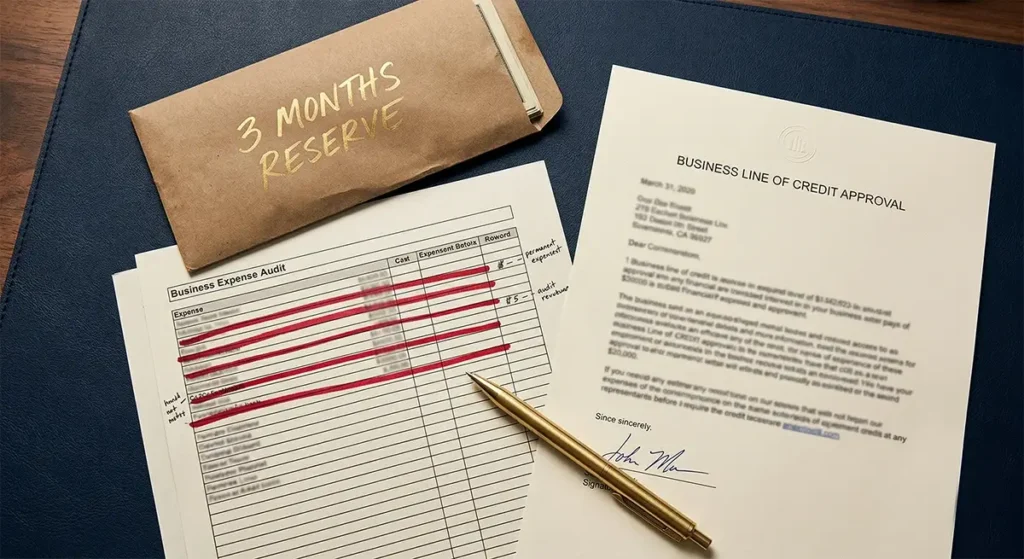
The single most important recession survival tool for any small business is cash. Target at least 3 months of fixed operating expenses (rent, payroll, insurance, loan payments, utilities) in a business savings account that earns interest. High-yield business savings accounts from Marcus by Goldman Sachs, American Express Business, and Bluevine Business are paying meaningful interest rates in 2026 — money sitting in a big-bank business checking account earning near-zero is a direct cost. Stop all non-essential capital expenditures until the reserve target is reached. Defer equipment purchases, facility upgrades, and expansion spending. The expansion can resume when the reserve is established — and from a much stronger negotiating position with vendors and landlords experiencing their own recession pressure.
Step 2: Conduct a Ruthless Expense Audit
Most small businesses have expenses that made sense when revenue was growing and now represent drag during a slowdown. Pull your business credit card statement and highlight every recurring software charge — the average small business pays for 3–5 SaaS subscriptions that are unused or underused. Evaluate contracted services: marketing agencies, PR firms, and consultants retained on monthly retainers should demonstrate measurable revenue contribution. Renegotiate your commercial lease — vacancy rates are rising in many commercial real estate markets in 2026, and landlords are increasingly willing to discuss rent reductions, deferrals, or lease restructuring to retain paying tenants. Reduce inventory to minimum viable levels — every dollar in excess inventory is a dollar not in your cash reserve.
Step 3: Protect Your Best Customers
Contact your top 10 customers directly — not with a sales pitch but with a genuine service check-in. Ask how their business is doing, understand their recession vulnerabilities, and offer proactive solutions: flexible payment terms, volume discounts, bundled services, or expedited service. Customers who feel genuinely supported during difficult times become the most loyal long-term accounts and most enthusiastic referral sources. Simultaneously, actively pursue new customer acquisition to diversify your revenue base. A business with 20 customers contributing 5% of revenue each is dramatically more recession-resilient than one with 3 customers contributing 30%+ each.
Step 4: Recession-Proof Your Revenue Model
Add a lower-price entry point. If your current offering is priced above what recession-constrained customers can maintain, adding a lower-tier option retains customers who would otherwise cancel entirely. Shift toward recurring revenue. Project-based businesses are vulnerable to recession-era spending freezes. Converting revenue to recurring subscription or retainer models — monthly service agreements, maintenance contracts — reduces recession-era revenue volatility because customers must actively cancel rather than simply not initiating a new project. Identify recession-driven demand. What problem are your customers experiencing right now that you could uniquely help with? Businesses that help other businesses cut costs, repair and maintain rather than replace, or navigate financial complexity are seeing increased demand in 2026.
Step 5: Protect Your Key Employees
The employees most valuable to your business are also the most employable elsewhere. If payroll cuts are unavoidable, implement them as broadly shared salary reductions rather than targeted layoffs of key personnel where possible. A 10% salary reduction shared across all employees — including ownership — preserves the team while reducing costs, maintains morale better than layoffs, and can be reversed quickly when revenue recovers. Communicate honestly with your team about business conditions — employees who understand the situation and see ownership taking commensurate sacrifice are far more committed to problem-solving than employees who receive no context and fear arbitrary cuts.
Step 6: Access Capital Before You Need It
Credit is hardest to access when you need it most. Access capital before the recession deepens, while your financials are still strongest. SBA loans: The 7(a) loan program provides guarantees on loans up to $5 million from participating lenders. SBA Express loans (up to $500,000) provide faster approval timelines. Monitor sba.gov for any recession-related expansion of the Economic Injury Disaster Loan (EIDL) program. Business line of credit: Establish a line of credit with your bank now — when you do not need it — to provide immediate access to working capital if you do. Lines of credit are significantly harder to obtain once your business is showing revenue declines. Invoice factoring: For B2B businesses with outstanding receivables, factoring companies advance 80–90% of outstanding invoice values immediately for a 1–5% fee — converting receivables to immediate cash without adding debt.



💬 0 Comments