
If you carry credit card debt heading into a recession — and approximately 50% of American cardholders do — understanding exactly how your card issuer will behave during an economic downturn is critical financial intelligence. Banks do not publicize their recession-era strategies, but the patterns are consistent across economic cycles and are well-documented. Here is what actually happens to credit cards during a recession — and what you can do about it.
During recessions, credit card issuers simultaneously tighten new credit availability, reduce existing credit limits on riskier accounts, and increase their monitoring for early signs of financial stress. These changes can happen with minimal notice and affect even cardholders who have never missed a payment. Understanding the early warning signs and taking proactive steps before your issuer acts unilaterally gives you significantly more control over your credit situation.
What Credit Card Issuers Do During Recessions
Reduce credit limits on existing accounts: During recessions, banks review their card portfolios for risk exposure and reduce credit limits on accounts they view as higher risk — even accounts with perfect payment histories. The criteria banks use include: high utilization relative to limit, recent income reduction (detectable through credit bureau data), new derogatory marks on your credit report, multiple recent inquiries, and accounts with balances near the limit. A credit limit reduction is legal with minimal notice (typically 15–45 days by law) and can happen suddenly.
The practical impact of a credit limit reduction: if your limit drops from $8,000 to $4,000 while you are carrying a $3,200 balance, your utilization rate jumps from 40% to 80% — immediately triggering a credit score decline of 30–50 points even though your behavior has not changed. This score decline can trigger additional limit reductions from other card issuers, creating a cascade that significantly damages your credit in a short period.
Tighten approval standards for new cards: During recessions, the minimum credit score required for new card approvals typically rises by 40–80 points across most issuer categories. Cards that were previously approvable at 680 may require 720–740 during a recession. New card applications are declined more frequently, and approved cards often come with lower initial limits. If you need to apply for credit, applying before a recession deepens — while your credit score and income are strongest — is strategically important.
Reduce or eliminate credit limit increases: The automatic credit limit increase offers that appear frequently in good economic times largely disappear during recessions. Issuers tighten their limit increase criteria and decline more requests even from long-standing customers with good payment histories.
Increase monitoring and risk scoring: During recessions, card issuers run more frequent risk assessments on their portfolios, using behavioral signals — where you shop, what you buy, late payments on other accounts — as early warning indicators of potential default. This increased monitoring is largely invisible to cardholders but means your account may be flagged and reviewed before you have any indication a change is coming.
What Happens to Credit Card Interest Rates During a Recession
Credit card interest rates follow the Prime Rate — which moves in lockstep with the Federal Reserve’s federal funds rate. When the Fed cuts rates during a recession, the Prime Rate falls, and variable-rate credit cards (the vast majority of American credit cards) lower their APR within 1–2 billing cycles. The mechanics: your credit card APR is typically expressed as “Prime Rate + X%” where X is your card’s margin. If your card is “Prime Rate + 17.99%” and the Prime Rate is currently 7.50%, your APR is 25.49%. If the Fed cuts rates by 0.50%, your APR drops to 25.00% — a $5/year reduction per $1,000 of balance. This provides modest relief but does not meaningfully change the debt burden of cardholders carrying large balances at 22–28% APR.
The practical implication: do not count on Fed rate cuts providing significant credit card debt relief. Even 1–2% APR reductions on high balances provide marginal monthly savings compared to the total interest burden. Aggressive debt paydown, balance transfers, or hardship program enrollment are far more impactful strategies than waiting for rate cuts.
Protective Steps to Take Before a Recession Deepens
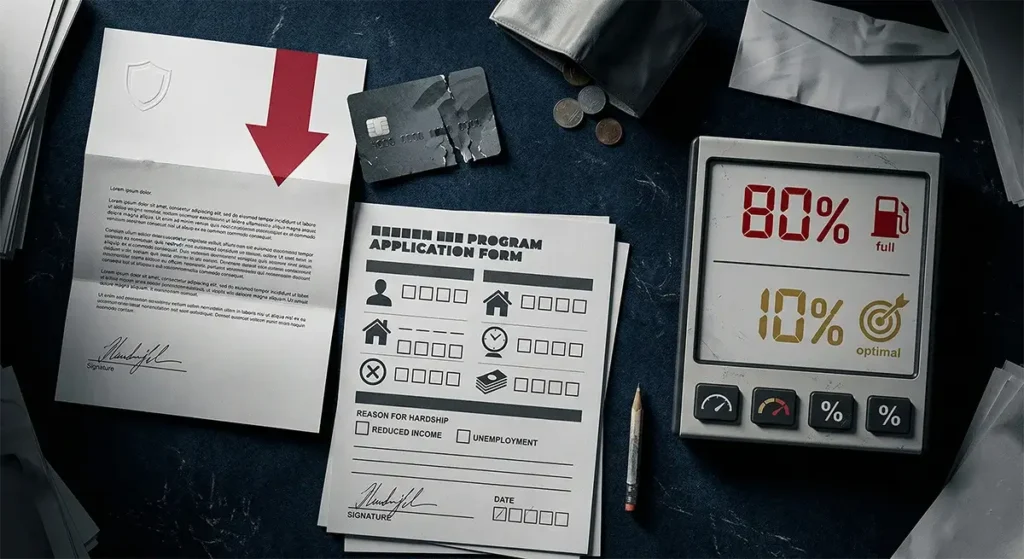
Pay down utilization before credit limits are cut. If your credit card balances are above 30% of your available credit, reducing them before a potential limit reduction protects your credit score from the utilization spike that a limit cut would cause. At 30% utilization on a $10,000 limit ($3,000 balance), a limit cut to $5,000 would move utilization to 60% — causing a meaningful score drop. At 10% utilization ($1,000 balance), the same limit cut to $5,000 only moves utilization to 20% — still within the “good” range.
Do not close unused credit cards. Closing a credit card reduces your total available credit — increasing your utilization ratio on remaining cards. During a recession, keeping zero-balance cards open (even if unused) maintains your total credit availability and keeps utilization low. The only cards worth considering closing are those with annual fees where the fee exceeds the value you receive — and even then, request a downgrade to a no-fee version of the same card rather than closing the account entirely.
Request a credit limit increase now. If your credit is in good shape (score 700+, income stable, low utilization), requesting a credit limit increase before recession conditions tighten bank lending standards can significantly improve your credit position. A higher limit provides more buffer before a potential recession-era limit reduction would damage your utilization ratio. Many issuers offer limit increases via soft inquiry (no credit score impact) — check your issuer’s mobile app for a “Request Credit Limit Increase” option.
Enroll in account alerts. Set up account alerts for: transactions above a threshold amount, payment due dates, credit limit changes, and balance thresholds. Being notified immediately when a limit change occurs allows you to respond quickly rather than discovering the change weeks later on a statement.
If You Are Struggling to Pay: Hardship Programs Before Delinquency
Every major credit card issuer maintains a financial hardship program that provides temporary relief — reduced APR (often to 0–9.99%), waived minimum payments for 2–6 months, or fee waivers — for cardholders experiencing income disruption. The critical requirement: these programs are accessible to current (non-delinquent) accounts. Once you miss a payment, collections protocols take over with far fewer options.
Call the number on the back of your card before you miss a payment. Ask specifically for the “financial hardship team” or “customer assistance program.” Explain your situation clearly and specifically — job loss, reduced hours, medical expense, or recession-related income reduction. Programs vary by issuer and individual circumstance. American Express, Chase, Citi, Capital One, and Bank of America all have these programs, though they are not prominently advertised.
Recession-Era Credit Card Management: The Priority Hierarchy
When recession-related financial pressure requires you to prioritize which bills to pay, credit card payments follow a specific priority logic. Always pay: rent or mortgage first (housing security takes absolute priority), utility bills (essential services), and food costs. Credit card payments follow, with priority given to the cards where non-payment triggers the most harmful consequences: secured cards (where default could result in collateral seizure), cards nearing credit limits (where default would cause immediate utilization and score damage), and cards with the highest APR (where missed payments accrue interest most rapidly).
If you must choose which credit card to pay when you cannot pay all of them, paying the minimum on all cards and making extra payments on the highest-rate card is the mathematically correct approach. Missing a payment entirely on any card triggers a 30-day delinquency on your credit report (a significant score event) and late fees — making partial payments on all cards preferable to full payment on some and missed payment on others.


💬 0 Comments