
A health savings account (HSA) is the single most tax-advantaged savings vehicle available under the US tax code — more tax-efficient, dollar for dollar, than a 401(k), Roth IRA, or any other savings account. Yet the majority of Americans who are eligible to open an HSA have not done so, and of those who have, most use it as a simple pass-through for current medical expenses rather than as the powerful long-term wealth-building tool it can be. Here is the complete guide to maximizing your HSA in 2026.
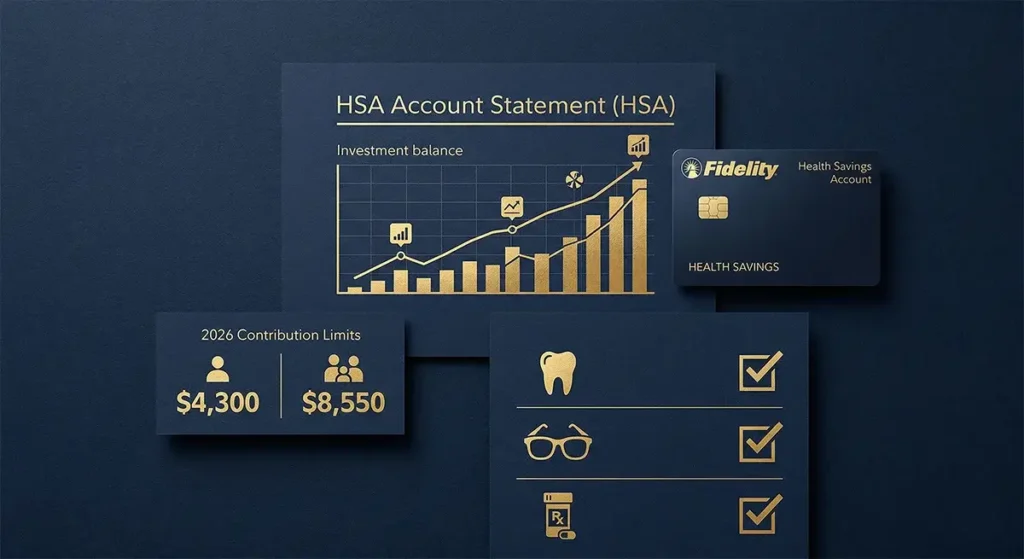
The HSA’s “triple tax advantage” — contributions are pre-tax, growth is tax-free, and qualified withdrawals are tax-free — makes it the only savings account in the US tax code that is never taxed at any stage of the savings lifecycle. Used correctly as a long-term investment account, an HSA funded at $4,300/year for 25 years at 7% average return grows to approximately $284,000 — entirely tax-free for qualified medical expenses, which are among the largest costs in retirement.
HSA Eligibility: Who Can Open One in 2026
To open and contribute to an HSA in 2026, you must be enrolled in a qualifying High-Deductible Health Plan (HDHP). The IRS defines an HDHP in 2026 as a health plan with a minimum deductible of $1,650 for self-only coverage or $3,300 for family coverage, and maximum out-of-pocket limits of $8,300 (self-only) or $16,600 (family). You cannot be enrolled in Medicare (any part), cannot be claimed as a dependent on someone else’s tax return, and cannot have other health coverage that is not an HDHP (with certain exceptions for preventive care, dental, vision, and limited purpose FSAs).
Verify your health plan’s HSA eligibility by looking for “HSA-eligible” or “HSA-compatible” in the plan description, or by checking the plan’s deductible against the 2026 minimums above. If your employer offers multiple health plan options during open enrollment, an HSA-eligible HDHP is almost always among them.
2026 HSA Contribution Limits and Deadlines
| Coverage Type | 2026 Contribution Limit | Catch-Up (Age 55+) | Total with Catch-Up |
|---|---|---|---|
| Self-Only HDHP Coverage | $4,300 | +$1,000 | $5,300 |
| Family HDHP Coverage | $8,550 | +$1,000 | $9,550 |
Contributions can be made until the federal tax filing deadline (April 15, 2027 for tax year 2026). If you have not yet maxed your 2026 HSA and are still within this window, contributing the maximum is one of the highest-return, zero-risk actions available in personal finance.
Employer HSA contributions count toward your annual limit. If your employer contributes $1,000 to your HSA, you can personally contribute $3,300 (self-only) or $7,550 (family) to reach the annual maximum. Many employees unknowingly over-contribute by ignoring the employer’s contribution when setting their own payroll deduction — resulting in excess contribution penalties of 6% on the over-contributed amount.
The Triple Tax Advantage: Why the HSA Beats Every Other Account
Every other major savings vehicle is taxed at least once:
- Traditional 401(k): Tax-deductible contributions, tax-free growth, taxable withdrawals
- Roth IRA: After-tax contributions, tax-free growth, tax-free qualified withdrawals
- Taxable brokerage: After-tax contributions, taxable growth (dividends, capital gains), taxable withdrawals
- HSA: Pre-tax contributions + FICA tax savings, tax-free growth, tax-free qualified withdrawals = truly zero tax across the entire lifecycle
The HSA’s FICA tax advantage is particularly noteworthy and often overlooked. Contributions made through payroll deduction to an employer-sponsored HSA are exempt from Social Security and Medicare taxes (FICA) — a 7.65% savings unavailable with any other retirement account. On a $4,300 annual contribution, this FICA exemption saves an additional $329/year that 401(k) and IRA contributions cannot match.
The Two HSA Strategies: Spender vs Investor
Most people use their HSA as a spending account — contributing money, paying medical expenses from the account, and maintaining a small balance. This is the HSA at its least powerful form. The alternative — and financially superior — approach treats the HSA as a long-term investment account:
The HSA Investment Strategy: Pay all current qualified medical expenses out of pocket (from your regular checking account), save all medical receipts and documentation, invest your full HSA balance in low-cost index funds within the HSA account, and allow the balance to compound tax-free for decades. At any future date — even 10–20 years later — you can reimburse yourself for the prior medical expenses (using your saved receipts) by withdrawing the equivalent amount from the HSA tax-free and penalty-free, regardless of when the original expense occurred.
This strategy converts your HSA into a stealth retirement account with no withdrawal restrictions on reimbursable medical expenses (which accumulate significantly over time) and with the additional safety valve that after age 65, HSA funds can be withdrawn for any purpose at ordinary income tax rates — identical to a traditional IRA. The HSA never becomes “worse” than an IRA, and for qualified medical expenses, it is significantly better.
Where to Open Your HSA for the Best Investment Options
If your employer offers an HSA through a payroll deduction arrangement, you benefit from the FICA tax exemption — but you may be limited to the investment options in their chosen HSA administrator (often a bank with limited, expensive fund options). Many HSA administrators allow you to open a second, investment-focused HSA at a different institution and transfer funds after contributing through payroll.
| HSA Provider | Monthly Fee | Investment Options | Best For |
|---|---|---|---|
| Fidelity HSA | $0 | Full brokerage access including zero-expense-ratio Fidelity funds | Best overall for investors — no fees, best fund selection |
| Lively HSA | $0 | TD Ameritrade brokerage; broad fund access | Excellent fee-free option with good investment tools |
| HSA Bank | $2.50/month (waived at $3,000+ balance) | TD Ameritrade brokerage | Widely used employer-sponsored option |
| HealthEquity | Varies by employer arrangement | Vanguard funds available; balance threshold to invest | Commonly offered through employers; good Vanguard access |
Fidelity HSA is the clear recommendation for self-directed investors — zero fees, full brokerage access including the Fidelity ZERO index funds (0.00% expense ratio), and direct contribution from your bank account. Open at fidelity.com/go/hsa.
Qualified Medical Expenses: What Your HSA Can Pay For
HSA qualified medical expenses are more extensive than most people realize. Beyond doctor visits, hospital bills, and prescription drugs, qualified expenses include: dental care (cleanings, fillings, crowns, dentures, orthodontia), vision care (glasses, contact lenses, LASIK surgery), hearing aids and batteries, mental health services and therapy, physical therapy and chiropractic care, prescription eyeglasses and contact lens solution, fertility treatments, long-term care insurance premiums (up to IRS limits), and Medicare premiums (Parts A, B, and D — but not Medigap supplements) after age 65.
Over-the-counter medications — a category expanded by the CARES Act in 2020 — are now qualified HSA expenses without a prescription: pain relievers, cold and flu medications, allergy medicines, antacids, first aid supplies, and menstrual care products. This expansion significantly broadens the universe of everyday expenses payable from your HSA tax-free.
HSA During a Recession: Strategic Considerations
In a recession when household budgets are under pressure, the HSA’s immediate tax benefit becomes more valuable. Contributing to an HSA through payroll reduces your taxable income dollar-for-dollar — providing an immediate tax refund equivalent to your marginal tax rate. For a worker in the 22% federal bracket and 5% state bracket, a $4,300 HSA contribution reduces their tax bill by approximately $1,161 — a guaranteed, immediate return of 27% that no investment can match.
If recession-related financial pressure forces a choice between reducing your 401(k) contribution or your HSA contribution, consider the HSA’s FICA tax advantage and the liquidity benefit (HSA funds can be accessed for medical expenses penalty-free at any time, unlike 401(k) funds which carry a 10% early withdrawal penalty before 59½). For younger workers with manageable 401(k) balances, maintaining HSA contributions during a recession is often the higher-priority decision.



💬 0 Comments