
Medical debt is the leading cause of personal bankruptcy in the United States and affects approximately one in four American adults. In 2026, with healthcare costs continuing to outpace inflation and recession-related financial pressure reducing household financial buffers, understanding how medical debt actually works — and what your rights are — is financially essential knowledge. This guide covers everything from billing errors to credit reporting to the landmark changes in medical debt rules that took effect in 2025.
The medical debt landscape changed significantly in 2025: the three major credit bureaus (Equifax, Experian, and TransUnion) removed all medical debt under $500 from credit reports, and the CFPB finalized a rule in January 2025 prohibiting medical debt from appearing on credit reports altogether — though this rule faces ongoing legal challenges. Additionally, the No Surprises Act protections against surprise medical billing remain in effect. Your rights regarding medical debt in 2026 are substantially stronger than they were three years ago.
The 2025–2026 Medical Debt Credit Reporting Revolution
Three landmark changes have dramatically altered how medical debt affects your credit score:
Change 1 (July 2022): Equifax, Experian, and TransUnion voluntarily removed paid medical debt collections from credit reports — meaning once a medical debt collection is paid, it immediately disappears from your credit report rather than remaining for 7 years.
Change 2 (April 2023): The three bureaus removed medical debt collections under $500 from credit reports entirely — regardless of payment status. This change eliminated the credit reporting consequences for the majority of medical debt collection accounts by dollar amount.
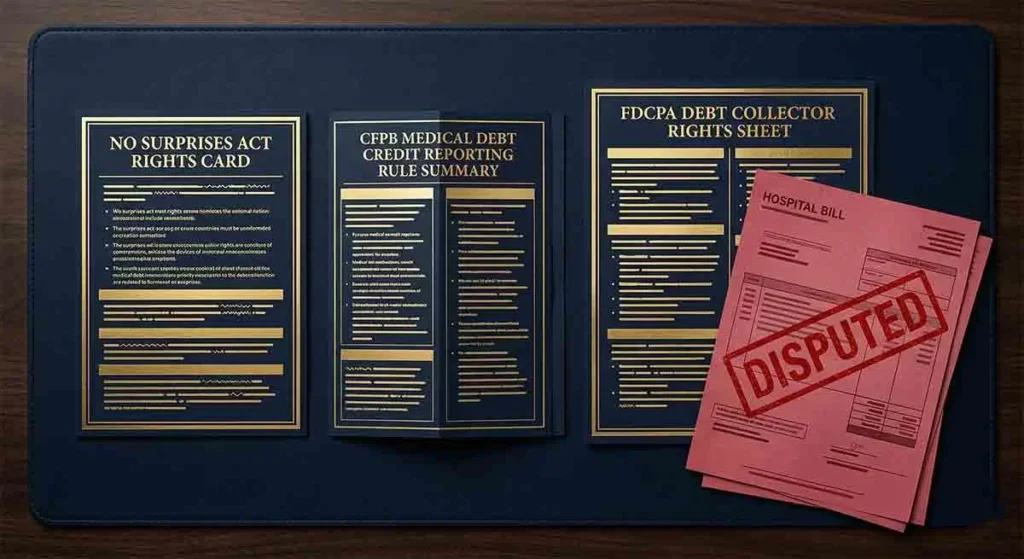
Change 3 (January 2025 — CFPB Final Rule): The Consumer Financial Protection Bureau finalized a rule prohibiting medical debt from being included in credit reports altogether, citing research showing medical debt is a poor predictor of creditworthiness and unfairly penalizes people for healthcare expenses. This rule is in effect but faces legal challenges from the credit reporting industry and has been subject to enforcement questions under changing administrative leadership — verify its current status at cfpb.gov before relying on it in your specific situation.
The practical result of these changes for consumers: medical debt collections have a significantly reduced credit score impact in 2026 compared to prior years — providing meaningful protection for the 100+ million Americans carrying some form of medical debt.
Your Rights Under the No Surprises Act
The No Surprises Act, which took full effect in January 2022, provides critical protections against surprise medical billing — a practice that had allowed out-of-network providers to send patients large unexpected bills for care received at in-network facilities. Key protections in 2026:
Emergency services protection: Emergency room care is protected from surprise billing regardless of whether the facility or providers are in your insurance network. For emergency services, you cannot be billed more than your in-network cost-sharing amounts, even if you are treated by out-of-network providers.
Non-emergency services at in-network facilities: Out-of-network providers at in-network facilities (the most common source of surprise bills — anesthesiologists, radiologists, assistant surgeons, and similar providers who work at in-network hospitals but are not themselves in-network) cannot bill you more than your in-network cost-sharing without your explicit, written consent obtained at least 72 hours before the service.
Air ambulance protection: Out-of-network air ambulance services are limited to in-network cost-sharing under the No Surprises Act — addressing one of the most extreme sources of unexpected medical bills, where a single air ambulance transport had previously generated bills of $30,000–$100,000 for uninsured or out-of-network patients.
How to invoke these protections: If you receive a bill that violates these protections, file a complaint at cms.gov/nosurprises. The No Surprises Act is enforced by the Department of Health and Human Services — complaints result in investigations and financial penalties for non-compliant providers.
Medical Debt Collection: Know Your Rights Under the FDCPA
When medical bills go unpaid and are sent to collections, the Fair Debt Collection Practices Act (FDCPA) provides important rights that limit how collectors can contact you and what they can do to collect the debt:
Debt collectors must identify themselves. They must tell you they are debt collectors, provide their company name, and notify you that any information you provide can be used to collect the debt.
You can request debt verification. Within 30 days of a collector’s first contact, you can send a written debt validation letter requesting that the collector verify the debt is accurate and that they have the right to collect it. The collector must stop collection activity until they provide verification. Request validation for any medical debt you do not recognize or believe is in error — this is one of the most powerful tools in disputing inaccurate medical debt.
You can request they stop contacting you. A written “cease communication” letter requires debt collectors to stop calling, writing, or contacting you — though they can still sue for the debt.
Collectors cannot harass, threaten, or use deceptive practices. Threatening to arrest you, threatening to report immigration status, calling before 8 AM or after 9 PM, and misrepresenting the debt amount are all FDCPA violations subject to penalties.
Statute of limitations on medical debt: Medical debt has a statute of limitations after which a creditor or collector cannot successfully sue to collect it. This period varies by state — typically 3–6 years from the date of last activity on the account. After the statute of limitations expires, the debt is “time-barred” — collectors can still contact you but cannot win a lawsuit against you. Never make even a small payment on a time-barred debt without consulting an attorney first — a payment may restart the statute of limitations clock.
Nonprofit Hospital Charity Care: Your Legal Right
As detailed in our post on negotiating medical bills, every nonprofit hospital is legally required by the IRS to provide financial assistance (charity care) to eligible patients. What many patients do not know: if a nonprofit hospital sends your bill to collections without first determining your eligibility for financial assistance, this may violate IRS regulations and state law in many states.
If your bill has gone to collections: contact the original hospital billing department (not the collection agency) and request to apply for financial assistance. Most nonprofit hospitals will recall the debt from collections to process your financial assistance application. The ACA specifically requires nonprofit hospitals to make reasonable efforts to determine patients’ eligibility for financial assistance before initiating extraordinary collection actions (including credit reporting, lawsuits, and wage garnishment).
Medical Debt and Bankruptcy: Understanding the Option
When medical debt is overwhelming and has no realistic path to resolution through negotiation or financial assistance, bankruptcy may be the appropriate legal remedy. Chapter 7 bankruptcy discharges most unsecured debt — including medical debt — and is available to individuals whose income falls below their state’s median income threshold. Chapter 13 bankruptcy restructures debt into a 3–5 year repayment plan for filers with income above the threshold.
The bankruptcy decision is serious and has lasting credit consequences (Chapter 7 remains on your credit report for 10 years; Chapter 13 for 7 years) — but it may be the financially rational choice when medical debt is so large that normal repayment is impossible, particularly when the alternative is years of wage garnishment, harassment, and financial paralysis. Consult a bankruptcy attorney — most offer free initial consultations — before making this decision. Many bankruptcy attorneys work on contingency or flat fees that are significantly less than the total debt they discharge.
Proactive Steps: How to Avoid Problematic Medical Debt Before It Occurs
Request the cash-pay price before any non-emergency service. Hospitals and medical practices maintain cash-pay pricing that is often 40–70% below their chargemaster (list) rates — and sometimes below even your insurance cost-sharing obligation, particularly when you have not met your annual deductible.
Verify network status for every provider. Before any procedure, confirm that the hospital, the surgeon, the anesthesiologist, the assistant surgeon, and the radiologist are all in-network under your insurance plan. Out-of-network providers at in-network facilities are now protected by the No Surprises Act, but verifying network status upfront prevents billing disputes entirely.
Keep records of all medical financial communications. Save every bill, every EOB, every negotiation letter, and every payment confirmation. These records are essential documentation for disputes, financial assistance applications, and billing error corrections.



💬 0 Comments