
High-yield savings accounts (HYSAs) have become one of the most widely discussed personal finance topics in the post-2022 interest rate environment — and in 2026, with rates still elevated relative to the near-zero era of 2010–2021, understanding how they work and how to choose the best one remains one of the highest-return simple financial decisions any American can make. Here is everything you need to know.
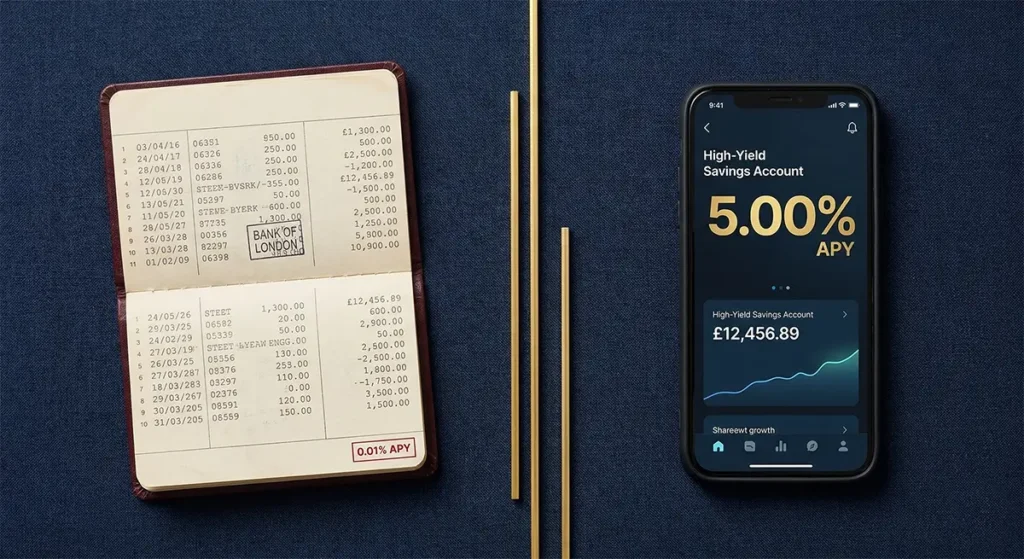
A high-yield savings account is simply a savings account — typically at an online bank — that pays significantly more interest than the national average. In 2026, the best HYSAs are paying 4.5–5.25% APY versus the national average savings rate of approximately 0.59% APY. On a $10,000 emergency fund, that difference is $466 vs $59 per year in interest — $407 of completely free, no-risk additional income simply by moving your savings to a better account.
What Is a High-Yield Savings Account?
A high-yield savings account is a standard FDIC-insured savings account that pays a significantly above-average interest rate, typically offered by online banks that have lower overhead costs than traditional brick-and-mortar banks and pass those savings on to depositors through higher interest rates.
HYSAs are not investment accounts. They carry no market risk — your principal is never at risk of loss. They are FDIC-insured up to $250,000 per depositor per bank, the same federal protection that covers your checking account at your local bank. The higher interest rate is the only meaningful difference between a HYSA and a standard savings account at a traditional bank.
The interest rate on a HYSA is expressed as APY — Annual Percentage Yield — which accounts for the effect of compound interest. A 5.00% APY account pays approximately 0.417% per month on your balance, with that interest added to your principal and earning additional interest going forward. APY is the correct metric to compare across accounts; APR (Annual Percentage Rate) without compounding produces a slightly lower effective return.
Why Traditional Bank Savings Accounts Pay Almost Nothing
The national average savings account interest rate at the end of 2025 was approximately 0.59% APY. At the nation’s largest banks — Chase, Bank of America, Wells Fargo — standard savings account rates remain stubbornly near 0.01–0.50% APY despite the Federal Reserve having raised its benchmark rate to 4.25–4.50%. Why?
Traditional banks have enormous branch networks, large marketing budgets, and a captive customer base that rarely compares rates. They have no financial incentive to raise savings rates because their existing customers are not leaving. Their business model relies on borrowing money cheaply from depositors (paying near-zero on savings) and lending it out at significantly higher rates (mortgages, credit cards, business loans) — capturing the spread as profit. When customers accept near-zero savings rates without shopping around, banks have no competitive pressure to raise them.
Online banks — which have no physical branches, minimal overhead, and compete aggressively for deposits through rate comparison websites — pass their cost savings on to depositors. The competitive dynamics of the online banking market produce HYSA rates 8–10 times higher than traditional bank savings rates on average.
Best High-Yield Savings Accounts in 2026
| Bank / Institution | APY (Early 2026) | Minimum Balance | Monthly Fees | FDIC Insured | Notes |
|---|---|---|---|---|---|
| Marcus by Goldman Sachs | 4.90% | $0 | None | Yes | No minimum, reliable rate history, Goldman Sachs backing |
| Ally Bank Online Savings | 4.70% | $0 | None | Yes | Excellent app and customer service, bucket savings feature |
| SoFi High-Yield Savings | 5.25% (with direct deposit) | $0 | None | Yes | Highest rate available but requires direct deposit |
| American Express High Yield Savings | 4.85% | $0 | None | Yes | Strong brand; no Amex card required to open |
| Discover Online Savings | 4.75% | $0 | None | Yes | Reliable rates, no fees, established brand |
| UFB Direct | 5.25% | $0 | None | Yes | Consistently among highest rates; division of Axos Bank |
| LendingClub High-Yield Savings | 5.10% | $0 | None | Yes | Competitive rate; debit card access available |
| Capital One 360 Performance Savings | 4.60% | $0 | None | Yes | Widely recognized brand; easy to open alongside checking |
Rates as of early 2026. HYSA rates are variable and change with Federal Reserve policy. Always verify current rates at the institution’s website before opening an account.
HYSA vs Money Market Account vs CD: Choosing the Right Tool
| Account Type | Typical 2026 Rate | Liquidity | Risk | Best Use |
|---|---|---|---|---|
| High-Yield Savings Account | 4.5–5.25% APY | Full — withdraw anytime | None (FDIC insured) | Emergency fund, short-term savings goals |
| Money Market Account | 4.5–5.0% APY | Full — check/debit access | None (FDIC insured) | Similar to HYSA; check-writing convenience |
| Certificate of Deposit (CD) | 4.0–5.5% APY (fixed) | Restricted — early withdrawal penalty | None (FDIC insured) | Known future expense in 6–24 months; lock in rate |
| Treasury Bills (T-Bills) | 4.5–5.2% APY | Can sell on secondary market | Effectively zero (US government) | Slightly higher yield than HYSA; more setup required |
| Standard Bank Savings | 0.01–0.59% APY | Full | None (FDIC insured) | Convenience only — not recommended for savings goals |
How Much Should You Keep in a HYSA?
A HYSA is specifically designed for money that needs to be both safe and accessible — primarily your emergency fund and any savings goals with a time horizon under 2–3 years. Financial planners universally recommend keeping 3–6 months of essential living expenses in a liquid, no-risk account. For a household with $4,000/month in essential expenses, that means $12,000–$24,000 in an emergency fund — ideally all of it in a HYSA earning 4.5–5%+ rather than a standard savings account earning 0.59%.
Beyond the emergency fund, money earmarked for specific near-term goals belongs in a HYSA: a down payment you plan to use within 24 months, a car replacement fund, a wedding fund, planned home repairs, or any other goal where you need the money by a specific date and cannot risk a market decline reducing its value. Money with a longer time horizon (retirement savings, college funds 10+ years away) belongs in invested accounts — a HYSA’s 5% APY does not compound to retirement-level wealth over long periods the way equity investment returns do.
Will HYSA Rates Fall in 2026?
HYSA rates are directly correlated with the Federal Reserve’s federal funds rate. When the Fed cuts rates, online banks lower HYSA rates within days to weeks. The current expectation among market participants — reflected in the CME FedWatch Tool — is that the Fed will cut rates 1–3 times in 2026 if recession conditions materialize, potentially reducing the federal funds rate from the current 4.25–4.50% range to 3.25–3.75% by year-end 2026.
If those cuts materialize, the best HYSA rates would likely decline from the current 4.5–5.25% range to approximately 3.5–4.25%. This still represents far better returns than traditional savings accounts (which would likely still pay 0.1–0.5% APY) and justifies maintaining savings in a HYSA regardless of rate direction. If you want to lock in current rates before anticipated cuts, a 12–18 month CD at current rates accomplishes this — at the cost of liquidity during the CD term.
How to Open a HYSA: Step by Step
Opening a HYSA takes approximately 10–15 minutes online. You will need: your Social Security number, a government-issued ID (driver’s license or passport), your current bank’s routing number and account number for the initial transfer, and a minimum opening deposit (most HYSAs have no minimum, but having $100–$500 ready for the initial transfer is typical). The process: visit the HYSA bank’s website directly, click “Open Account,” complete the application (identity verification), link your existing bank account, and transfer your initial deposit. Your account is typically open and earning interest within 1–3 business days.
One practical note: keep a small amount in your existing bank’s savings account rather than transferring 100% to your HYSA. Having $500–$1,000 at your primary bank covers the timing gap between transfers (which take 1–3 business days) and any immediate cash needs. The HYSA is your savings vault; your primary checking and small savings buffer remain at your existing bank for day-to-day convenience.



💬 0 Comments