The average American family of four spent $1,212 per month on food in 2024 — and tariff-driven food price increases in 2026 have pushed that figure higher for many households. Yet food is the most controllable major expense in the household budget. Unlike rent or car payments, grocery spending can be reduced by 30–50% within a single month through systematic strategies — without meaningful sacrifice in nutrition, variety, or meal quality.
Households that cut their grocery bills in half do not eat worse — they shop smarter. Implementing all strategies below typically produces 35–55% grocery savings for the average American family. Implementing just the top 5 produces 20–30% savings within the first month. The $400–$600 in monthly savings generated by optimizing food spending is among the most accessible forms of recession financial relief available to most American households.
Where Grocery Money Disappears
| Overspending Driver | Estimated % of Grocery Budget Lost | Primary Cause |
|---|---|---|
| Food waste (bought, not eaten) | 20–30% | Impulse buying, poor planning, oversized quantities |
| Name brand premium over store brands | 15–25% | Habit, brand loyalty, marketing |
| Impulse purchases | 10–20% | Shopping hungry, no list, strategic product placement |
| Convenience premium foods | 10–20% | Pre-cut produce, pre-marinated proteins, retail meal kits |
| Non-grocery items in grocery stores | 5–10% | Household supplies bought at grocery markup |
Strategy 1: Meal Planning — The Foundation
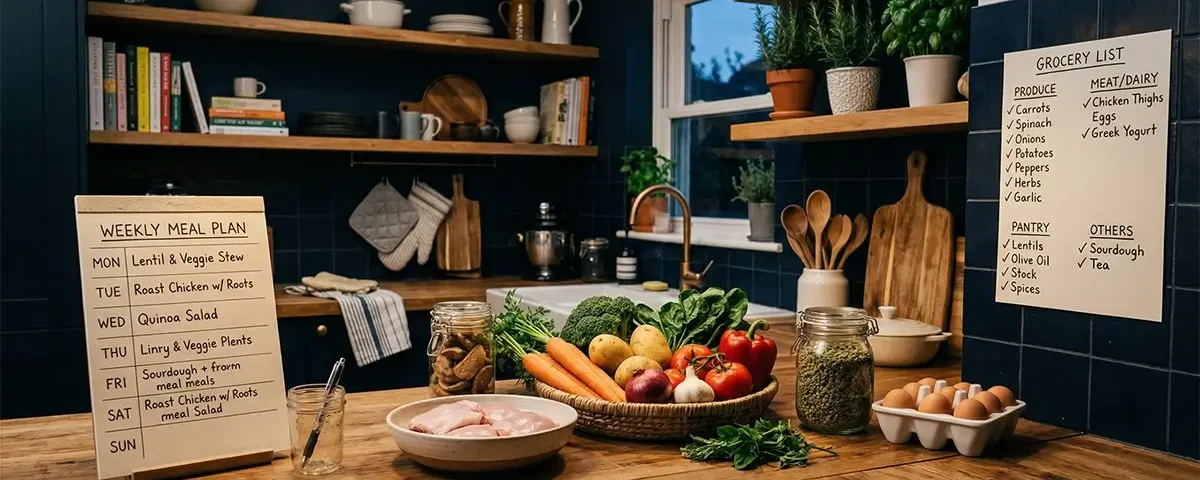
Meal planning is the prerequisite for every other grocery savings strategy. The effective weekly process takes 20–30 minutes: check your refrigerator, freezer, and pantry for items that need to be used; plan 5–7 dinners around what you already have plus strategic purchases; derive a shopping list from those planned meals specifically; shop only from that list. This single practice typically reduces grocery spending by 20–30% in the first week — not from deprivation but from eliminating random purchases that never get used. For households that find meal planning difficult to maintain, batch cooking once per week on Sunday — preparing a large batch of grains, a large protein, and roasted vegetables — provides components for 8–10 different meals throughout the week.
Strategy 2: The Store Brand Switch
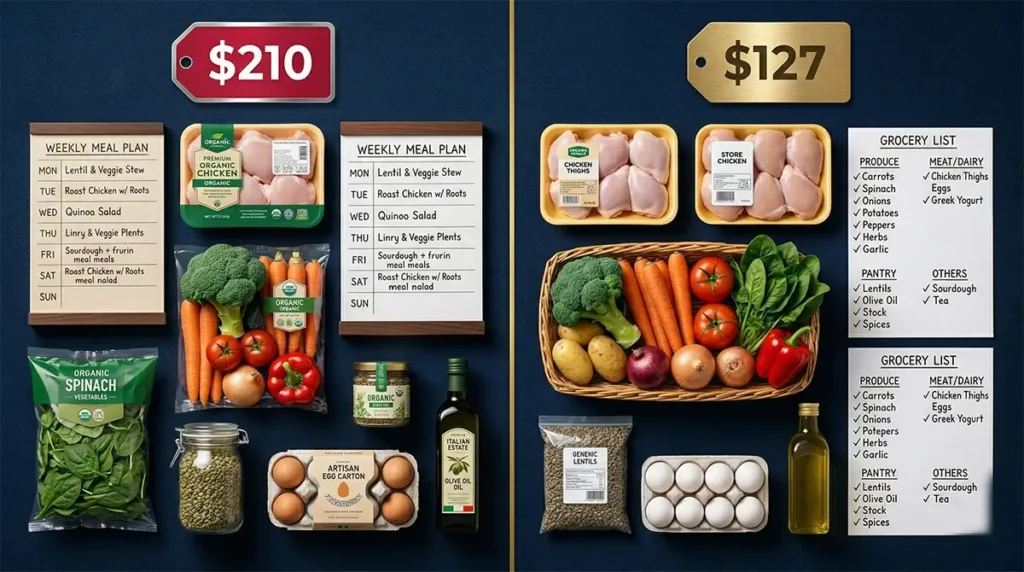
Consumer Reports taste testing and multiple academic studies consistently find that for commodity grocery items, store brands are indistinguishable from name brands in blind taste tests — and cost 20–40% less. Always buy store brand for: canned vegetables and beans, pasta, rice, flour, sugar, oats, frozen vegetables and fruit, eggs, butter, vegetable oil, olive oil, milk, shredded cheese, cream cheese, sour cream, plain yogurt, over-the-counter medications (FDA-regulated to identical standards as name brands), and paper products. A household that converts 70% of grocery purchases to store brands saves approximately $150–$250/month on a typical $600–$800/month grocery budget — with no change in nutrition or meal quality.
Strategy 3: Strategic Protein Sourcing
| Protein Source | Cost per 100g Protein (approx. 2026) |
|---|---|
| Dried lentils | $0.40–$0.70 |
| Dried beans | $0.50–$0.90 |
| Eggs (large, dozen) | $0.80–$1.20 |
| Canned tuna (light) | $1.00–$1.50 |
| Chicken thighs (bone-in) | $1.50–$2.50 |
| Ground beef (80/20) | $3.00–$4.50 |
| Boneless chicken breast | $3.50–$5.00 |
A household that replaces 2–3 protein-heavy meals per week with beans, lentils, or eggs saves approximately $80–$150/month while meeting or exceeding protein nutrition targets.
Strategy 4: Buy Seasonal Produce, Buy Frozen for Everything Else
Fresh produce prices vary by a factor of 3–5x between in-season and out-of-season availability. Buying whatever is cheapest at your store this week and building meals around seasonal availability saves $50–$100/month for families who purchase significant fresh produce. For produce consumed cooked rather than raw, frozen is almost always the better value — it is picked at peak ripeness, nutritionally equivalent to fresh by most research standards, and 40–60% cheaper. Frozen peas, corn, broccoli, spinach, edamame, and mixed vegetables are all equivalent to fresh for cooked applications.
Strategy 5: Shop at Multiple Stores Strategically
Grocery store pricing is highly inconsistent across product categories. Strategic multi-store shopping — buying each category at the store with consistently lowest prices — typically saves 15–25% versus buying everything at a single mid-tier grocery chain. Discount grocers (Aldi, Lidl, WinCo, Market Basket): typically 20–40% cheaper than conventional supermarkets on most categories. Aldi and Lidl’s private-label model eliminates the name brand premium entirely. Warehouse clubs (Costco, Sam’s Club): superior unit pricing on pantry staples and proteins for households that will use the quantities before expiration — membership fees are recovered within 2–3 shopping trips for pantry-staple buyers.
Strategy 6: Use Digital Coupons and Store Apps
Most major grocery chains have app-only discounts that require zero effort to claim beyond downloading the app and scanning your loyalty card. Kroger, Safeway, Albertsons, Target Circle, and Walmart Savings Catcher all offer weekly digital coupons that can reduce a typical grocery trip by $5–$20 with no behavior change other than clicking to load offers before shopping. Ibotta, Fetch Rewards, and Receipt Hog provide additional cash back on grocery purchases — scan your receipt after every trip and redeem points for cash or gift cards.
Strategy 7: Reduce Dining Out Systematically
The average American household spends $3,008 per year dining out and ordering delivery — approximately $251/month. Reducing this by half (by cooking dinner at home 5 of 7 nights instead of 3 of 7 nights) saves approximately $125/month while improving nutrition for most families. The key enabler: a well-stocked pantry and freezer that makes cooking dinner easier than ordering delivery. When cooking feels effortless, delivery feels unnecessary rather than tempting.
The 10 No-Sacrifice Grocery Rules
1. Never shop hungry. 2. Shop alone. 3. Use the store’s app for digital coupons. 4. Check the clearance rack for 30–50% off items expiring today — buy and use or freeze. 5. Compare unit prices, not package prices — the larger package is not always the better value. 6. Cook from scratch — a homemade stir-fry costs $2–$3 per serving versus $6–$9 for prepackaged. 7. Freeze bread before it goes stale — bread freezes and toasts perfectly. 8. Keep a running pantry inventory — most households have $50–$150 in pantry items that could become a week’s worth of meals. 9. Try one plant-based protein dinner per week — saves the average family $30–$60/month with no reduction in nutritional quality. 10. Plan protein around weekly sales — if chicken thighs are $0.89/lb this week, make two chicken thigh meals and freeze extra.



💬 0 Comments