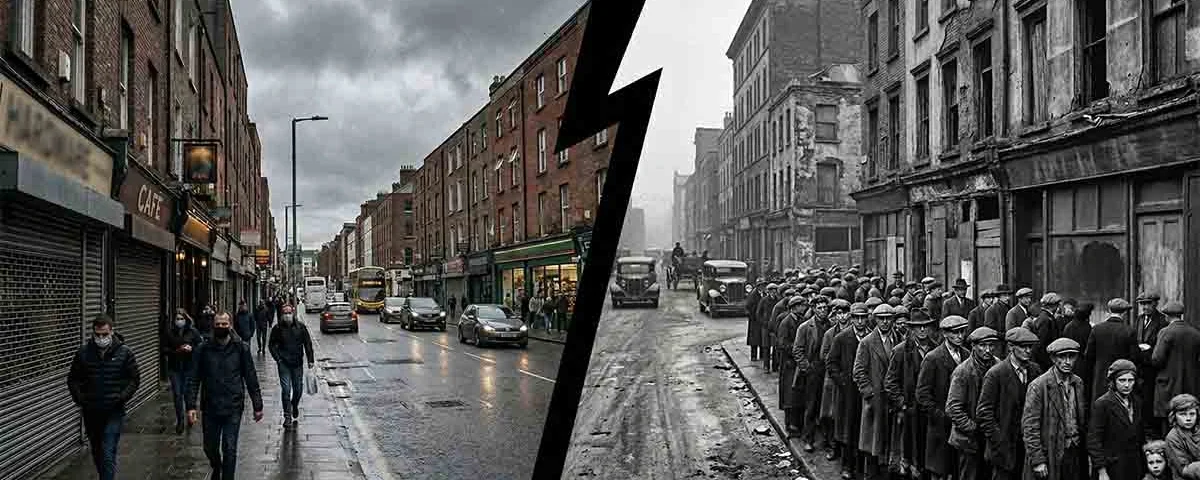
People often use the words “recession” and “depression” interchangeably in everyday conversation, but they describe fundamentally different economic conditions with dramatically different implications for American households. Understanding the recession vs depression difference is not merely an academic exercise in 2026 — it is essential for making informed financial decisions, interpreting economic news accurately, and avoiding the kind of panic-driven mistakes that cost families money during periods of uncertainty. When a cable news commentator warns of “depression-level conditions” or a social media post claims “this is worse than the Great Depression,” the ability to evaluate those claims against actual economic definitions and historical data is a valuable financial skill.
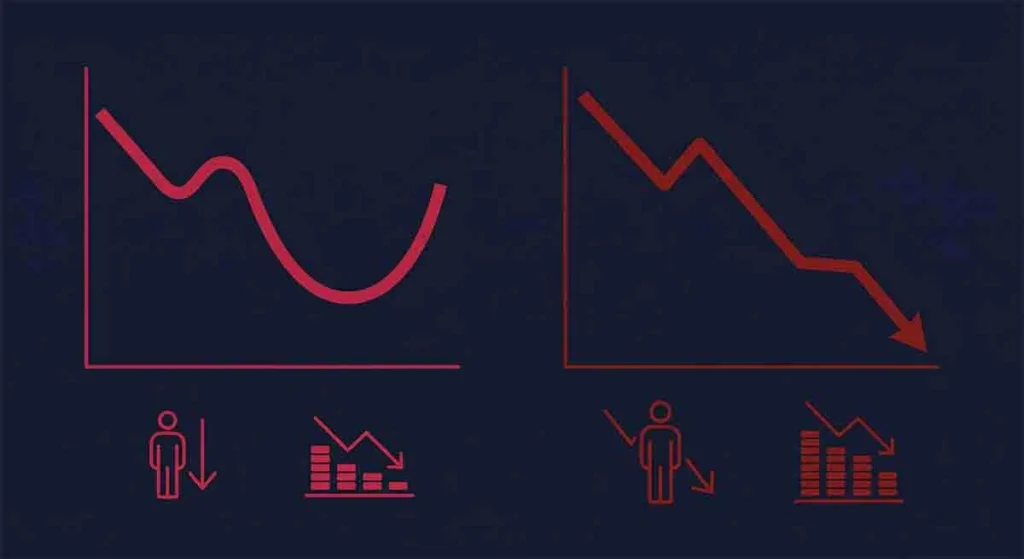
A recession is a significant but temporary decline in economic activity lasting months to roughly 18 months, with GDP declining 1 to 5 percent and unemployment rising to 5 to 12 percent. A depression is a catastrophic, prolonged collapse lasting years, with GDP falling more than 10 percent and unemployment exceeding 20 percent. The United States has experienced only one depression — the Great Depression of 1929 to 1939 — while it has experienced more than 30 recessions. The structural safeguards built into the modern US economy make a depression essentially impossible under current institutional frameworks.
What Is a Recession? Definition and Characteristics
A recession is officially defined in the United States by the National Bureau of Economic Research (NBER) as a significant decline in economic activity that is spread across the economy and lasts more than a few months. The NBER considers employment, real personal income, industrial production, real personal consumption expenditures, and wholesale-retail sales when making its determination (source: nber.org/research/business-cycle-dating).
The defining characteristics of a recession include a contraction in gross domestic product (GDP) typically ranging from 1 to 5 percent, a rise in unemployment from 1 to 5 percentage points above pre-recession levels, reduced consumer spending as households pull back on discretionary purchases, declining business investment as companies postpone capital expenditures, and tightening credit conditions as banks become more cautious about lending. Recessions typically last 6 to 18 months, with the average post-World War II recession lasting approximately 10 months according to NBER data.
During a recession, the economy is contracting but still functioning. Banks remain open and solvent (with FDIC insurance protecting deposits up to $250,000). Government services continue operating. Most businesses remain in operation, though some may reduce hours, freeze hiring, or conduct layoffs. The stock market typically declines 20 to 35 percent from peak to trough but continues trading. The critical distinction is that a recession, while painful, is a cyclical and temporary event within a fundamentally sound economic system.
The most recent US recessions illustrate the range of severity. The COVID-19 recession of February to April 2020 lasted only 2 months and was the shortest on record, despite producing a dramatic 9.1 percent GDP decline in Q2 2020, because massive fiscal and monetary stimulus produced an equally dramatic recovery. The Great Recession of December 2007 to June 2009 lasted 18 months and produced a 4.3 percent GDP decline, but even this — the most severe recession since the 1930s — was fundamentally different from a depression.
What Is a Depression? Definition and Characteristics
There is no universally agreed-upon formal definition of an economic depression, which is itself revealing — the concept is so rare that economists have never needed to standardize its definition. However, the characteristics commonly associated with a depression include a GDP decline exceeding 10 percent from peak to trough, unemployment rates exceeding 20 percent, a duration of multiple years (typically 3 to 10 years), widespread deflation (falling prices across the economy rather than inflation), systemic banking failures involving hundreds or thousands of financial institutions, and a breakdown in normal credit and financial intermediation.
The United States has experienced only one event that meets these criteria: the Great Depression of 1929 to 1939. During the Great Depression, US GDP fell approximately 30 percent from its 1929 peak to its 1933 trough. Unemployment reached 24.9 percent in 1933 according to Bureau of Labor Statistics historical data (bls.gov). More than 9,000 banks failed between 1930 and 1933, wiping out the savings of millions of Americans who had no deposit insurance. Deflation was severe, with the consumer price level falling approximately 25 percent between 1929 and 1933. Industrial production fell by roughly 47 percent. International trade collapsed by approximately 65 percent.
The human toll was catastrophic and lasting. Families lost their homes, their savings, and their livelihoods for years. Breadlines, shanty towns (called “Hoovervilles”), and mass migration characterized the decade. The social, political, and psychological effects of the Depression shaped American economic policy and public attitudes toward government intervention for generations.
Recession vs Depression: Side-by-Side Comparison
| Factor | Recession | Depression |
| Duration | 6 to 18 months | 3 to 10+ years |
| GDP Decline | 1 to 5% | 10%+ |
| Peak Unemployment | 5 to 12% | 20%+ |
| Price Behavior | Mixed (can be inflationary or deflationary) | Severe deflation |
| Banking System | Strained but functional; FDIC-insured | Systemic failure; mass bank closures |
| Credit Availability | Tighter but available | Frozen or collapsed |
| Stock Market | 20 to 35% decline typical | 80%+ decline (1929-1932) |
| Government Response | Monetary + fiscal stimulus | Initially inadequate; eventually transformative |
| Frequency | Every 5 to 10 years on average | Once in US history (1929-1939) |
| Recovery Pattern | V-shaped or U-shaped | L-shaped; decade-long |
Why a Depression Is Essentially Impossible in 2026
The structural safeguards built into the modern US economy since the 1930s make a depression-level collapse virtually impossible under current institutional frameworks. These safeguards did not exist when the Great Depression occurred, and their absence was precisely what allowed a severe recession to cascade into a decade-long catastrophe.
The Federal Deposit Insurance Corporation (FDIC), established in 1933 and now insuring deposits up to $250,000 per depositor per bank, has eliminated the bank-run dynamic that destroyed thousands of institutions during the Depression. Since the FDIC’s creation, no insured depositor has ever lost a single penny of insured deposits (source: fdic.gov).
The Federal Reserve, while it existed during the Depression, initially tightened monetary policy rather than easing it — a catastrophic policy error that deepened and prolonged the downturn. Modern Federal Reserve doctrine, informed by decades of economic research including Milton Friedman and Anna Schwartz’s definitive analysis in A Monetary History of the United States, ensures that the central bank now responds to financial crises with aggressive monetary easing rather than contraction. The Fed’s 2008-2009 response (cutting rates to zero, deploying quantitative easing, creating emergency lending facilities) and its 2020 response (similar tools deployed even more rapidly) demonstrate this institutional learning.
Automatic fiscal stabilizers — unemployment insurance, Social Security, SNAP, Medicaid — did not exist before the New Deal but now automatically inject hundreds of billions of dollars into the economy during downturns without requiring any new legislation. These programs maintain household income and spending at levels that prevent the catastrophic demand collapse that characterized the Great Depression.
The Dodd-Frank Wall Street Reform and Consumer Protection Act of 2010 imposed capital requirements, stress testing, and resolution authority on systemically important financial institutions, reducing the probability of the kind of cascading bank failures that turned the 2008 financial crisis into the worst recession since the 1930s.
Even under the worst-case scenarios economists model for 2026 — including sustained conflict in the Middle East, persistent oil price elevation, and compounding tariff effects — projections show GDP declining 1 to 3 percent and unemployment reaching 6 to 9 percent. These figures, while painful, are firmly in recession territory and nowhere near depression thresholds.
Why the Distinction Matters for Your Financial Decisions
Understanding the recession vs depression difference has direct practical implications for how you manage your money in 2026. If you believe a depression is coming, the rational financial response is extreme: liquidate all investments, hoard cash, eliminate all debt immediately regardless of interest rate, and prepare for years of unemployment. This is what Americans did in 1930-1933 — and for many, it was the correct response given the institutional failures of that era.
If you correctly understand that a recession — not a depression — is the realistic risk scenario, your financial response should be calibrated accordingly. Maintain a 6 to 12 month emergency fund in a high-yield savings account earning 4 to 5 percent APY. Continue contributing to retirement accounts (401k, IRA) because market declines during recessions create buying opportunities that historically produce above-average returns over the following 5 to 10 years. Avoid panic-selling investments, which locks in losses right before the recovery typically begins. Pay down high-interest consumer debt, particularly credit cards, but do not liquidate retirement savings to do so.
The most expensive financial mistakes during recessions come from treating them as depressions. Investors who sold stocks during the March 2020 COVID crash missed a recovery that brought the S&P 500 to new all-time highs within months. Workers who accepted early Social Security benefits at 62 during the 2008 recession permanently reduced their monthly payments by up to 30 percent for a downturn that lasted 18 months.
For authoritative, real-time economic data to help you assess conditions yourself, consult the Bureau of Economic Analysis (bea.gov) for GDP data, the Bureau of Labor Statistics (bls.gov) for employment data, and the Federal Reserve Economic Data portal (fred.stlouisfed.org) for a comprehensive range of economic indicators.


💬 0 Comments