
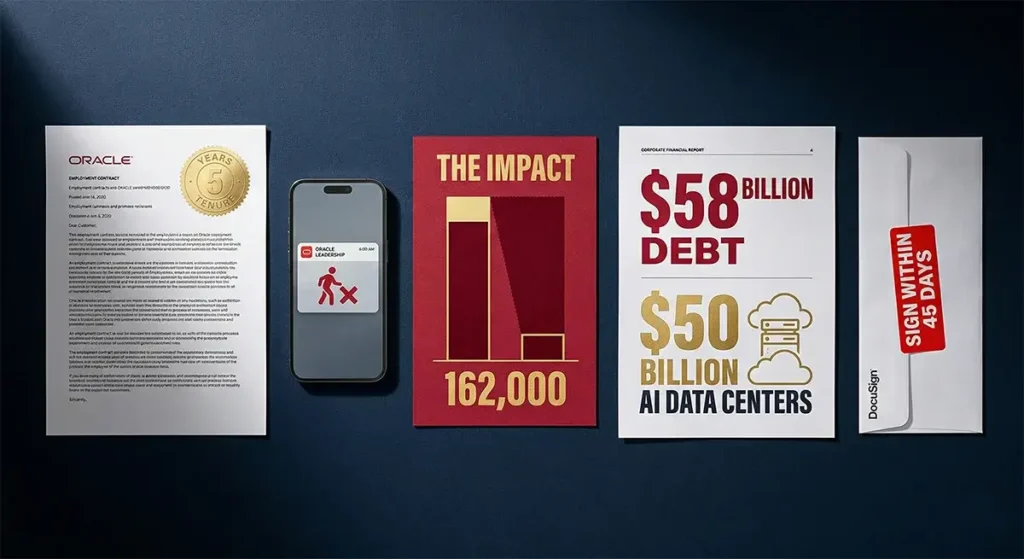
At approximately 6:00 a.m. EST on March 31, 2026, thousands of Oracle Corporation employees across the United States, India, Canada, Mexico, and other countries opened their email inboxes to find a single message from “Oracle Leadership” — and learned, in the time it takes to read three short paragraphs, that their careers at one of the world’s largest technology companies were over. No prior call from HR, No meeting with a manager and No advance notice of any kind. Just a brief, formulaic email informing them that their role had been eliminated “as part of a broader organizational change,” that today was their last working day, and that a severance package would be available after signing paperwork through DocuSign. Access to company systems was revoked within minutes of the message arriving.
What unfolded over the following hours was what analysts are now calling the most extensive layoff in Oracle’s history — and one of the largest single-day workforce reductions in the technology industry in recent memory. Investment bank TD Cowen estimates the cuts will affect between 20,000 and 30,000 employees — approximately 18% of Oracle’s global workforce of roughly 162,000 people. As of the time of publication, Oracle has not officially confirmed the total number of affected employees.
Oracle’s mass layoff of up to 30,000 employees is not a sign of business failure — the company’s remaining performance obligations stand at $523 billion, up 433% year-over-year. It is a deliberate trade of human capital for AI infrastructure capital: Oracle needs $8–$10 billion in annual cost savings to service $58 billion in new debt taken on to fund a $500 billion AI data center buildout. Every eliminated position is effectively being converted into server capacity. For affected employees, understanding your legal rights — particularly around WARN Act notice requirements and severance negotiation — is the most urgent financial priority.
The Financial Crisis Behind the Cuts: Oracle’s $500 Billion AI Bet
To understand why Oracle is eliminating as many as 30,000 jobs, it is essential to understand the financial pressure the company has placed itself under in pursuit of artificial intelligence infrastructure dominance. The story begins with a $300 billion agreement with OpenAI, disclosed in September 2025, which committed Oracle to providing the computing infrastructure for one of the world’s most ambitious AI development programs — the Stargate initiative. The total Stargate commitment, a joint project involving Oracle, SoftBank, and OpenAI, carries a staggering $500 billion price tag.
To fund this buildout, Oracle has gone to the debt markets at an extraordinary pace. According to analysis from multiple financial institutions, Oracle took on approximately $58 billion in new debt in just the two months prior to the layoff announcement — including a $50 billion bond offering in February 2026 alone. The company has also committed to approximately $50 billion in capital expenditures for fiscal year 2026, an unprecedented investment rate for a company of Oracle’s size and cash flow profile. This spending level has created what TD Cowen described in its January 2026 research note as an acute “cash crunch” — the gap between Oracle’s revenue and the capital demands of its AI ambitions.
The scale of the financial commitment is visible in Oracle’s own SEC filings. The company disclosed a $2.1 billion restructuring plan in a recent regulatory filing, with nearly $1 billion already recorded — with the company stating that most of the restructuring costs stem from employee severance payments. That single sentence in a regulatory document represents the financial abstraction of what tens of thousands of workers are experiencing as the end of their careers at Oracle.
TD Cowen’s analysis is direct about the mechanism: the job cuts are expected to free up $8 billion to $10 billion in annual cash flow — money that Oracle urgently needs to service its debt obligations and fund the ongoing data center construction that its AI commitments require. This is not cost-cutting driven by business decline. Oracle’s remaining performance obligations — the contracted revenue that has not yet been recognized — stood at $523 billion as of the most recent quarter, up an extraordinary 433% year-over-year. The company’s Q3 fiscal 2026 earnings were strong enough to send its stock higher. The layoffs are a direct trade: people for infrastructure, headcount for data center capacity.
How the Layoffs Were Executed: The 6 a.m. Email
The manner in which Oracle executed its layoffs has drawn as much attention as the scale. Workers across the United States, India, Canada, Mexico, and other countries reported receiving the same termination notice at nearly the same hour — approximately 6:00 a.m. EST in the US, 3:00 a.m. PST, and early morning hours corresponding to US Eastern time in international offices. The message was sent under the name “Oracle Leadership” rather than from any individual executive or HR representative.
The email, screenshots of which were widely shared on Reddit’s r/employeesOfOracle community and the professional forum Blind within hours of the first notifications, read in its entirety:
“We are sharing some difficult news regarding your position. After careful consideration of Oracle’s current business needs, we have made the decision to eliminate your role as part of a broader organizational change. As a result, today is your last working day. We are grateful for your dedication, hard work, and the impact you have made during your time with us. After signing your termination paperwork, you will be eligible to receive a severance package subject to the terms and conditions of the severance plan. You will receive an email from DocuSign to your Oracle email address with details on your severance and termination date.”
Employees were instructed to update their personal email addresses in Oracle’s internal system to receive subsequent communications. Access to internal systems, Slack accounts, VPN, and in many cases company-issued laptops, was revoked within minutes to hours of the email’s delivery. Posts on Blind separately alleged that Oracle had recently installed monitoring software on company-issued Mac laptops capable of logging all device activity, with warnings circulating among affected employees not to copy any files or code before returning their machines.
The personal impact described across social platforms is striking. One employee wrote of being one month short of a 15-year service anniversary. Another described colleagues who had their stock vest date just two days after their termination date — a coincidence that drew immediate scrutiny and accusations of deliberate timing. Several employees noted that entire teams — not just individuals — were eliminated simultaneously, with some units reporting 30% or greater reductions in a single sweep. At least one manager was confirmed among those let go. People in sales, support, engineering, and product management roles all reported being affected.
Which Divisions and Geographies Were Hardest Hit
Based on reports from affected employees across social media platforms in the hours following the announcements, the layoffs appear to have been broad-based across Oracle’s organizational structure rather than concentrated in any single division. Several specific units have been identified as severely affected:
Oracle Communications GBU: Multiple employees reported layoffs across sales and support functions within the Communications Global Business Unit. One employee noted that “multiple people in sales and support have been impacted” with additional cuts expected throughout the quarter.
Revenue and Health Sciences (RHS): Reports indicate this division saw at least a 30% headcount reduction, with 16 or more engineers from individual units affected in a single sweep — suggesting the elimination of entire teams rather than individual position cuts.
SaaS and Virtual Operations Services (SVOS): Similar to RHS, this unit reportedly experienced significant reductions, with multiple levels of engineers and managers affected simultaneously.
NetSuite India Development Centre (IDC): Oracle’s NetSuite division — the cloud-based ERP product that serves small and medium businesses — had its India development center affected, with cuts spanning product management, individual contributor, and manager roles across multiple levels.
Oracle Cloud Infrastructure (OCI): The OCI division, which is central to Oracle’s AI infrastructure strategy, reportedly experienced significant cuts in a previous wave in the months prior, and additional cuts appear to have occurred in this latest round. Reports on Blind indicate that “several hundred impacted in OCI” with individuals ranging from new graduate to senior director level affected.
Geographically, the layoffs have been confirmed to affect employees in the United States, India (where early-morning email notifications created particular alarm given the time difference), Canada, and Mexico. European operations, including teams in Romania, and Asia-Pacific operations in the Philippines, Japan, and Australia, have also been mentioned in employee accounts, though official confirmation of cuts in these geographies remains pending.
The Severance Package: What Affected Employees Are Receiving
The severance structure disclosed to affected employees is contingent on signing separation documentation through DocuSign — a condition that employment attorneys uniformly caution requires careful review before acceptance. Key elements of the severance arrangement as reported by affected employees:
Years of service formula: Severance payments are reportedly calculated based on tenure — a standard formula based on years of service paid out in monthly increments. The specific formula has not been officially disclosed by Oracle and may vary by geography and employment contract terms.
Unvested equity forfeited immediately: Employees with unvested Restricted Stock Units (RSUs) — including at least some employees who were days away from scheduled vesting dates — had those unvested shares forfeited immediately upon termination. This aspect has generated particular outrage among affected employees who were terminated shortly before scheduled vesting events.
Vested stock retained: Employees who had already vested shares were informed they would retain access to those shares through Fidelity — the brokerage platform Oracle uses for equity administration.
Garden leave period: Some employees noted April 3, 2026 as their formal last working day with a one-month garden leave period to follow — meaning some affected employees will technically remain employed through late April while being compensated to not work.
Benefits continuation: Details on health insurance continuation (COBRA eligibility) and other benefits have not been widely reported as part of the initial email communication — affected employees should verify their specific COBRA election window, which is typically 60 days from the qualifying event date.
The Legal Landscape: WARN Act, Severance Rights, and What Employees Should Know
The manner in which Oracle has executed these layoffs — same-day termination via email with no advance notice — raises significant legal questions that every affected employee should understand before signing any separation agreement.
The WARN Act and 60-day notice requirement: The federal Worker Adjustment and Retraining Notification (WARN) Act requires employers with 100 or more employees to provide 60 days’ advance written notice before conducting a “mass layoff” or “plant closing” that affects 50 or more employees at a single location. If Oracle failed to provide the required 60-day advance notice for qualifying layoff events at specific locations, affected employees at those locations may be entitled to 60 days of back pay and benefits — regardless of whether they signed a severance agreement. The WARN Act’s location-by-location application means employees must research whether the specific Oracle facility or location where they were employed triggered the notification requirement. Employment attorneys who specialize in WARN Act claims can evaluate this without upfront cost, as many take these cases on contingency.
Review period before signing severance: Under the Older Workers Benefit Protection Act (OWBPA), employees age 40 and over are entitled to at least 21 days to consider a severance agreement, and 45 days when the termination is part of a group layoff program. Regardless of age, no employment attorney will recommend signing a severance agreement on the day it is received. The severance offer is not withdrawn if you take the review time — Oracle wants signed agreements and will allow the review period.
Non-compete and non-disparagement clauses: Severance agreements typically include non-compete and non-disparagement provisions that restrict your ability to work for competitors or speak publicly about your termination. The enforceability of non-compete agreements has been significantly curtailed in many states (California prohibits them entirely; the FTC’s nationwide non-compete ban, though currently in litigation, has influenced state-level enforcement). Have an attorney review any non-compete language before signing.
State unemployment insurance: Employees terminated through no fault of their own are eligible for state unemployment insurance. File immediately upon termination — benefit eligibility begins from the week you file, not from the termination date, meaning delays in filing cost you weeks of benefits. Severance payments may affect the timing of unemployment benefit eligibility depending on your state’s specific rules regarding how severance pay is treated.
The Broader Tech Layoff Context: Oracle Is Not Alone
Oracle’s mass layoff is the largest single event of 2026’s technology industry restructuring wave, but it is part of a pattern that has been building throughout 2025 and accelerating in early 2026. The common thread is identical across companies: massive capital commitments to AI infrastructure that require cost reductions elsewhere to maintain financial viability.
Amazon, Google, Meta, and Microsoft have each announced capital expenditure plans ranging from roughly $115 billion to $200 billion for fiscal 2026 — with AI and cloud data centers as the primary destination. Oracle’s situation is described by analysts as more acute than these hyperscalers specifically because Oracle lacks their balance sheet depth, requiring debt financing at a scale that has compressed its free cash flow dramatically. The $58 billion in new debt in two months represents a financial bet of extraordinary magnitude for a company with Oracle’s cash flow profile.
The broader implication for the technology workforce in 2026 is significant: AI is simultaneously the reason companies are investing at unprecedented scale and the justification for eliminating the human roles that AI is expected to perform or augment. Some of Oracle’s cuts are being specifically directed at “job categories that the company expects it will need less of due to AI,” according to people familiar with the matter who spoke to Bloomberg when the layoffs were first reported on March 5, 2026. The humans whose work AI will automate are being terminated before the AI systems that will replace their functions are fully deployed — a sequencing that maximizes the financial benefit of the workforce reduction while leaving the operational capability gap to be filled by technology that is still under construction.
Oracle’s Business Performance: Strong Revenue, Deteriorating Cash Position
The financial paradox at the center of Oracle’s mass layoff is that the company is not struggling by most traditional business metrics. Its remaining performance obligations — contracted future revenue — grew 433% year-over-year to $523 billion, driven by the massive Stargate and other AI infrastructure agreements. Its Q3 fiscal 2026 earnings were strong enough to produce a stock price jump on the day of the earnings call. Revenue has grown at 8–11% annually in recent years, reaching over $57 billion.
What has deteriorated is Oracle’s cash position and free cash flow — the immediate financial resources needed to service the debt it has taken on for the AI buildout. The company acknowledged in its most recent earnings call that it had no plans to raise additional debt in 2026 — a statement that simultaneously signals discipline and reveals the urgency of the cost-reduction mandate. The $2.1 billion restructuring charge already disclosed, generating $8–$10 billion in annual cash flow savings from reduced payroll, is the financial mechanism that makes the AI infrastructure commitment serviceable. Without the workforce cost reduction, Oracle’s debt load and capital commitment would produce negative free cash flow — an unsustainable position for any company, regardless of its contracted revenue backlog.
What Comes Next: The Oracle Workforce After the Cuts
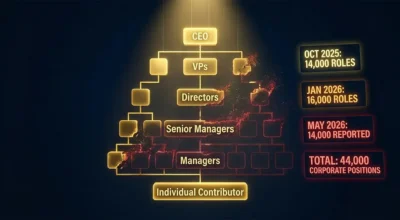
Based on TD Cowen’s analysis and employee reports, the cuts may not be over in a single wave. Multiple employees on Blind and the Layoff.com forums have referenced expectations of additional cuts in future quarters, with one report suggesting the total could reach 20,000 positions in the US alone with significant additional cuts in European and Asia-Pacific operations still to come. The Oracle Communications sale of Cerner, its electronic health records subsidiary acquired for $28 billion in 2022, has also been floated in TD Cowen’s analysis as a potential additional asset sale to further ease the cash flow pressure from the AI buildout.
For the employees who survived this round of cuts, Oracle’s workforce reality has been permanently altered. Teams have been reduced by 20–30% in some units. Workloads that required the eliminated positions will either be redistributed to remaining employees, deferred, or addressed through the AI tools that Oracle is building the infrastructure to support. The company’s simultaneous position as the builder of AI data center infrastructure and an organization using AI to justify eliminating its own workers captures the central paradox of the technology industry’s current moment.
Immediate Action Steps for Oracle Employees Affected by the Layoffs
If you received the Oracle termination email this morning, these are the priority actions ranked by urgency and financial impact:
1. Do not sign the severance agreement immediately. You have 21–45 days to review it (21 days if under 40; 45 days for group layoffs if 40 or older under OWBPA). Take the time. An employment attorney can review the agreement — particularly non-compete clauses, non-disparagement provisions, and whether the severance amount is appropriate for your tenure and role — often for a flat fee of $300–$500 or on contingency for potential WARN Act violations.
2. File for unemployment benefits today. Do not wait. File with your state’s unemployment agency immediately. Benefits run from the week you file, and every day of delay is a day of potential benefits forfeited.
3. Verify your COBRA election rights. You have 60 days from the qualifying event (your termination date) to elect COBRA continuation coverage for your health insurance. COBRA premiums are expensive, but health insurance lapses are often more expensive in practice. Explore Marketplace plans at healthcare.gov as an alternative — termination qualifies you for a Special Enrollment Period.
4. Document everything. Save any emails related to your termination to a personal email address. Note your exact tenure dates, any promises made about compensation or equity, and any communications about the termination process. This documentation is essential if you pursue any legal remedies or negotiate a severance improvement.
5. Consult with a WARN Act attorney. If you are at a location where 50 or more employees were terminated simultaneously without 60 days’ advance notice. You may have a WARN Act claim. Many WARN Act attorneys work on contingency — they collect fees only from settlements, not from you upfront. The potential recovery is up to 60 days of pay and benefits.


💬 0 Comments