
Receiving a rent increase notice is stressful — but it is not the end of the conversation. In 2026, with the rental market softening in many US cities due to new apartment supply and recession-related demand cooling, tenants have more negotiating leverage than they have had in several years. This guide gives you the complete playbook for negotiating a rent increase — including exactly what to say, what data to use, and what to offer if your landlord will not budge on price.
Landlords lose 4–8 weeks of rent income every time they turn over a unit — advertising costs, cleaning, repairs, and vacancy while finding a new tenant. For most landlords, accepting a reduced rent increase from a reliable, paying tenant is mathematically better than losing that tenant and absorbing vacancy costs. This reality is your primary negotiating leverage. Use it explicitly.
Understanding the 2026 Rental Market Before You Negotiate
Negotiation leverage depends entirely on market conditions. Before you respond to any rent increase notice, spend 30 minutes researching the current rental market in your specific area. The relevant data points:
Local vacancy rates: Markets with vacancy rates above 6–7% favor tenants; markets with vacancy rates below 4% favor landlords. In 2026, vacancy rates have risen in many metropolitan areas due to a wave of new apartment construction completing in 2024–2025. Cities including Austin, TX; Phoenix, AZ; Nashville, TN; and Charlotte, NC have seen particularly significant inventory increases that have shifted market power toward renters. Check your local apartment market by searching “[your city] apartment vacancy rate 2026” — this data is frequently reported by local news outlets and commercial real estate firms like CoStar and Apartment List.
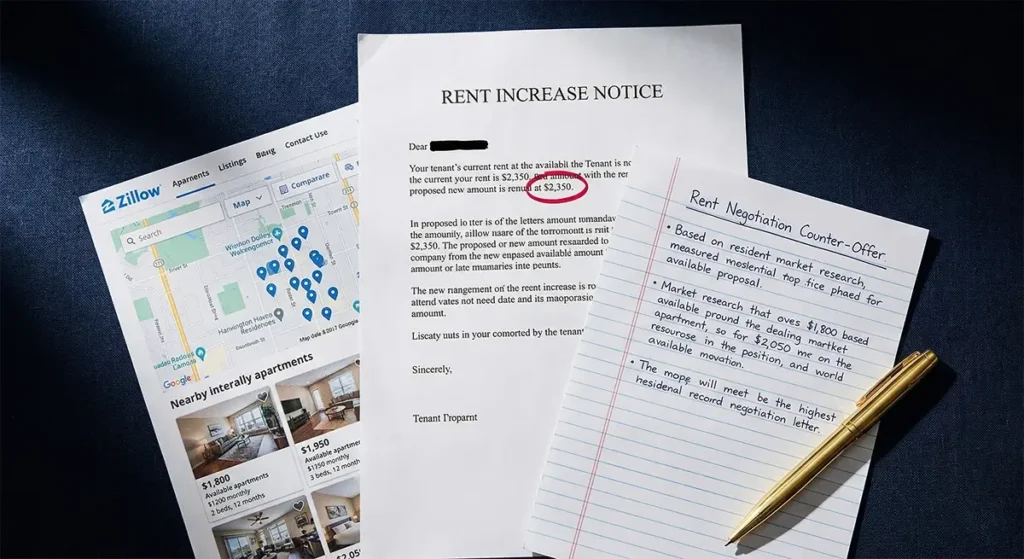
Comparable rental prices: Search Zillow, Apartments.com, and Rent.com for comparable units in your neighborhood with similar square footage, bedrooms, and amenities. If comparable units are renting for less than your proposed new rent, this is your strongest data-based argument. Screenshot comparable listings with price, address, and features to present to your landlord.
How long similar units are sitting vacant: If you see listings that were posted weeks or months ago on Zillow still showing as available, this is evidence that landlords in your area are struggling to fill units — significantly strengthening your negotiating position.
The Vacancy Cost Argument: Your Most Powerful Tool
When you sit down to negotiate, leading with the landlord’s vacancy cost is more effective than leading with your personal financial hardship. Landlords are business operators making financial decisions — appeal to their financial logic rather than their sympathy.
The average cost of turning over a rental unit includes: 4–8 weeks of vacancy (lost rent), professional cleaning ($150–$400), repainting ($400–$1,200 for a standard apartment), minor repairs ($200–$800), advertising the unit ($100–$500 for professional photos and listing fees), and screening new applicants (time and effort). In total, a landlord typically loses the equivalent of 1.5–3 months of rent every time a tenant vacates — before accounting for the risk that the replacement tenant may be less reliable.
On a $1,800/month apartment, a tenant turnover costs the landlord $2,700–$5,400 in lost income and expenses. If the landlord is proposing to raise your rent by $150/month ($1,800/year), you can make the explicit argument: “I understand you need to raise rent, but if I need to move, your turnover cost will likely be $3,000–$5,000 — significantly more than the $1,800 annual increase you are proposing. Would you consider meeting me at $75/month rather than $150/month, which keeps both of us better off?”
How to Write Your Rent Negotiation Request
Put your negotiation request in writing — either email or a formal letter. A written request is more professional, creates a record of the conversation, and gives your landlord time to consider your arguments without the pressure of an in-person response. Here is a template you can adapt:
“Dear [Landlord/Property Manager Name], Thank you for the renewal notice for [unit address]. I have been a tenant here for [X] years and have consistently paid rent on time throughout my tenancy. I would like to discuss the proposed rent increase of [amount/percentage]. I have researched comparable units currently available in [neighborhood] and found several similar apartments renting for [comparable price] — [approximately $X below] the proposed new rate. I value my home here and would prefer to renew rather than relocate. Given my track record as a tenant and current market conditions, I would like to propose a renewal at [your counter-offer amount]. I am happy to sign a [12 or 24]-month lease at this rate, which would provide you with guaranteed occupancy and eliminate the cost and uncertainty of finding a new tenant. Please let me know if this works for you. I am available to discuss at your convenience. Thank you for your consideration.”
This template works because it: establishes your track record immediately, presents market data (not just personal preference), proposes a specific counter-offer, offers something of value to the landlord (lease commitment, guaranteed occupancy), and is respectful and professional in tone.
What to Offer in Exchange for a Lower Increase
Negotiation is most effective when both parties get something of value. Beyond simply pushing back on price, consider offering the landlord something that has genuine value to them in exchange for a lower rate:
Longer lease commitment: Offering to sign a 18-month or 24-month lease instead of a standard 12-month lease provides your landlord guaranteed occupancy and eliminates the risk of another vacancy negotiation in 12 months. Many landlords will reduce a proposed increase in exchange for the certainty of a longer lease term.
Early payment commitment: Offering to pay rent on the 1st (versus a grace period date), or even offering 3–6 months upfront, eliminates administrative hassle and late payment risk for the landlord. Some smaller landlords value payment reliability more than maximum rent extraction.
Minor maintenance responsibility: Offering to handle minor maintenance tasks yourself (replacing light bulbs, minor caulking, small repairs under $50) reduces the landlord’s maintenance call frequency and has real value for self-managing landlords.
Referral of qualified tenants: If your building has vacancies, offering to refer qualified friends or colleagues who are looking for housing has real economic value — word-of-mouth referrals reduce marketing costs and tenant screening risk.
Rent Increase Limits: Know Your Legal Protections
Before any negotiation, verify whether your city or state has rent control or rent stabilization laws that limit how much your landlord can legally increase your rent.
In 2026, the following jurisdictions have meaningful rent control or stabilization protections: California (cities including Los Angeles, San Francisco, Oakland, Berkeley, Santa Monica, and others), New York City (rent-stabilized apartments), Oregon (statewide rent stabilization limiting increases to 7% + CPI for buildings over 15 years old), New Jersey (varies by municipality — many NJ cities have rent control ordinances), Washington D.C., and several other cities including St. Paul, MN, and Boulder, CO.
If your unit is covered by rent control, your landlord may only be legally permitted to increase your rent by a specific percentage — often 3–5% per year. Any increase above the legally permitted amount is illegal and you can report it to your local rent control board. Many tenants pay illegal rent increases simply because they do not know their legal protections. Verify your status at your city or county’s rent control board website.
If Your Landlord Will Not Negotiate: Your Options
Accept the increase and stay: If comparable market rents are equal to or higher than your proposed new rent, accepting may be the financially rational choice — moving costs (first month + last month + security deposit + moving expenses + utility setup fees) typically total $3,000–$8,000, which at a $150/month increase would take 20–53 months to offset in rent savings.
Move to a comparable unit at a lower rent: If the rental market research reveals genuinely lower rents available for comparable units, moving produces real savings — after the break-even point on moving costs. Calculate your moving cost break-even: divide your total expected moving costs by the monthly rent savings. If you can find a unit $200/month cheaper and your moving costs are $3,000, your break-even is 15 months.
Consider roommate arrangements: Adding a roommate to your current unit (if your lease permits) at the new higher rent can result in a lower net housing cost for you than your pre-increase individual payment. Verify your lease terms on subletting and additional occupants before pursuing this option.

💬 0 Comments