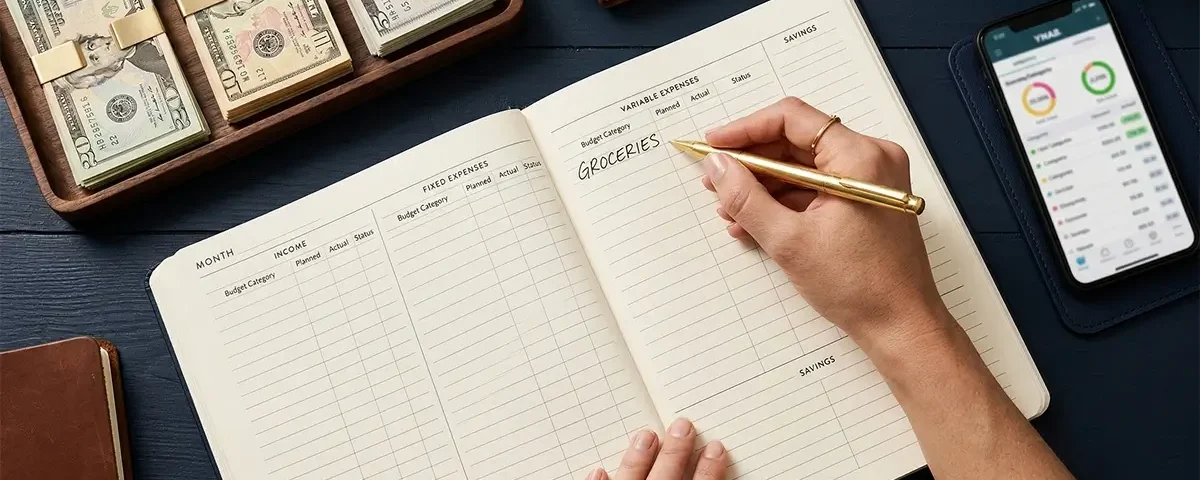
Most Americans who say they cannot make a budget have never been shown how to make one that actually works with real human psychology rather than against it. The budgets that fail are built on restriction and guilt. The budgets that succeed are built on intentionality and clarity. Here is the complete system for creating a monthly budget that you will actually follow — regardless of your income level.
A working budget is not a spreadsheet that tracks where money went — it is a spending plan that decides where money goes before it arrives. Every dollar assigned a purpose before the month begins means no dollars disappearing into unaccounted spending. This single shift from reactive tracking to proactive planning is the foundation of every successful budget.
Step 1: Calculate Your True Monthly Income
Your budget must begin with your actual take-home pay after all taxes and deductions — not your gross salary. For variable-income earners, use your lowest typical month as your baseline. For variable-income earners, the income-smoothing approach works well: deposit all income into a single account, pay yourself a fixed “salary” each month based on your lowest typical monthly income, and let surplus months build a buffer. List every income source: primary job take-home, side hustle net income after estimated taxes, rental income, government benefits, and any other regular monthly inflow.
Step 2: List Every Fixed Expense
| Fixed Expense | Your Amount | Notes |
|---|---|---|
| Rent or mortgage | $____ | Include escrowed property tax and insurance |
| Car payment(s) | $____ | Separate each vehicle |
| Auto insurance | $____ | Divide annual premium by 12 if paid annually |
| Health insurance premium | $____ | From your pay stub — your share only |
| Minimum debt payments | $____ | Credit cards, personal loans, student loans |
| Childcare or school tuition | $____ | |
| All subscriptions | $____ | List every one individually — total surprises most people |
| Phone plan | $____ |
Subtract total fixed expenses from monthly income. The remaining amount is your discretionary budget — the money available for variable expenses and savings after fixed commitments are met.
Step 3: Calculate Your Variable Expenses
Pull your last 3 months of spending from your bank or credit card statement. Calculate the average in each category. This is your realistic spending baseline — not what you think you spend, but what you actually spend. Categories to track separately: groceries, gasoline and transportation, utilities (average your last 12 months for seasonal accuracy), dining out and coffee (track this separately from groceries — most people dramatically underestimate this number), personal care and clothing, healthcare and copays, and entertainment and recreation.
Step 4: Budget for Irregular but Predictable Expenses
The budget category that destroys most people’s plans is irregular expenses — costs that do not occur monthly but are entirely predictable: car registration, annual insurance premiums, holiday gifts, back-to-school shopping, annual subscription renewals, medical deductibles, home maintenance, and vehicle maintenance. The system: add up every non-monthly expense you will incur in the next 12 months. Divide the total by 12. Set aside that amount every month into a dedicated “irregular expenses” savings account separate from your emergency fund. When the car registration comes due, the money is already there.
Step 5: Assign Every Remaining Dollar to Savings Goals
After all expenses are covered, every remaining dollar should be assigned to a specific savings goal in priority order. Priority 1: Emergency fund (if not fully funded — until you have 3–6 months of essential expenses, this is the highest-priority savings goal). Priority 2: Employer 401(k) match capture (contributing enough to capture your full employer match is the highest guaranteed return available to any American worker). Priority 3: High-interest debt elimination (every available dollar targeting credit cards and personal loans above 10% APR). Priority 4: Additional retirement contributions. Priority 5: Other savings goals (down payment, education savings, vacation).

The Best Budgeting Tools in 2026
YNAB (You Need A Budget): The gold standard for zero-based budgeting at ~$14.99/month — pays for itself many times over for most users. Copilot: AI-powered budget app for iOS at $13/month. Credit Karma (formerly Mint): Free automatic transaction tracking — better for tracking than proactive planning. Google Sheets: The most customizable option at zero cost — a simple template maintained 15 minutes per week is often more effective than any app because the manual entry process builds budget awareness that automated apps can obscure.
Making the Budget Stick: The Psychology of Sustainable Budgeting
Budgets that work long-term are not maximally restrictive — they are realistic. Every sustainable budget includes some amount of personal spending money that each adult can spend on whatever they want without justification. Couples who budget together successfully hold a brief 15–20 minute monthly budget meeting to review the prior month and align on the next month’s plan before it starts. Track spending weekly — mid-month check-ins allow you to course-correct before you have overspent a category, rather than discovering the overage after it cannot be undone.



💬 0 Comments