
Social Security is the financial foundation for approximately 70 million Americans — retirees, disabled workers, and surviving family members who depend on their monthly benefit as either their primary or supplementary income. In 2026, with recession risk elevated and economic uncertainty rising, the question on millions of minds is: what happens to Social Security during a recession, and are my benefits safe?
Social Security benefits are not directly cut during recessions — your monthly payment does not decrease because GDP falls or unemployment rises. However, recessions affect Social Security in three important indirect ways: they reduce the program’s trust fund revenues (less payroll tax collected from fewer employed workers), they may trigger more disability claims, and they may pressure Congress to make structural changes to the program. Understanding these dynamics helps you plan realistically.
How Social Security Is Funded: The Basic Structure
Social Security is primarily funded through payroll taxes under the Federal Insurance Contributions Act (FICA). Both employees and employers pay 6.2% each on wages up to the Social Security wage base ($176,100 in 2026) — a combined 12.4% of covered wages flowing into Social Security’s trust funds. Self-employed individuals pay the full 12.4% themselves (though half is deductible).
Social Security operates two distinct trust funds: the Old-Age and Survivors Insurance (OASI) Trust Fund, which pays retirement and survivors benefits, and the Disability Insurance (DI) Trust Fund, which pays disability benefits. These funds hold US Treasury bonds — they do not invest in stocks or other markets. The trust funds collect more than they pay out in strong economic years (building reserves) and pay out more than they collect in weak economic years (drawing down reserves).
What Recessions Do to Social Security’s Finances
Recessions reduce Social Security revenues through two mechanisms. First, when workers are laid off, they stop contributing payroll taxes — reducing incoming FICA revenue immediately. During the 2008–2009 recession, for example, the rapid rise in unemployment from 4.7% to 10% sharply reduced payroll tax collections, accelerating the timeline for trust fund depletion by several years according to the Social Security Administration’s own trustees reports.
Second, recessions tend to increase the number of early retirement claims. Workers who lose their jobs at age 62 or older and cannot find new employment often claim Social Security retirement benefits early rather than remaining unemployed — accepting permanently reduced benefits (up to 30% less than their full retirement age benefit) in exchange for immediate income. This increases benefit expenditure while simultaneously reducing future benefit liability (because early claimants receive smaller checks for the rest of their lives).
Third, recessions increase Social Security Disability Insurance (SSDI) claims as workers with health conditions who were managing to remain employed lose their jobs and apply for disability benefits. SSDI approval rates and processing times are significant topics — the average SSDI decision takes 3–6 months at initial application, and most initial applications are denied, requiring an appeal process that can take 12–24 months.
Are Social Security Benefits Safe During a Recession?
For current beneficiaries, Social Security payments are protected during recessions by statute. The Social Security Act requires benefits to be paid on schedule regardless of economic conditions — there is no mechanism by which a recession automatically reduces or suspends benefit payments. The federal government can and does borrow from the general treasury to continue benefit payments if trust fund revenues fall short — as was done during the 2020 COVID recession.
The legitimate long-term concern about Social Security’s finances is the projected trust fund depletion — currently estimated by the Social Security Trustees to occur in 2033 (OASI) under current law. If the trust fund is depleted and no legislative action is taken, incoming payroll tax revenue at that point would cover approximately 77–79% of scheduled benefits. This means a potential automatic benefit reduction of approximately 21–23% — not elimination, but a meaningful cut affecting all beneficiaries.
| Scenario | Impact on Social Security Benefits | Probability |
|---|---|---|
| Mild recession in 2026 | No change to current benefits; minor acceleration of trust fund depletion timeline | High if mild recession occurs |
| Severe prolonged recession | No change to current benefits; meaningful acceleration of trust fund depletion — potential earlier legislative action required | Low-moderate |
| Trust fund depletion without legislation (2033) | Automatic reduction to ~77–79% of scheduled benefits if no Congressional action | Low — Congress has acted in every prior Social Security funding crisis |
| Congressional reform before depletion | Gradual changes including possible benefit adjustments for future retirees, tax increases, or both | High — historical precedent strongly suggests legislative action |
Social Security’s COLA: How Inflation Affects Your Benefit
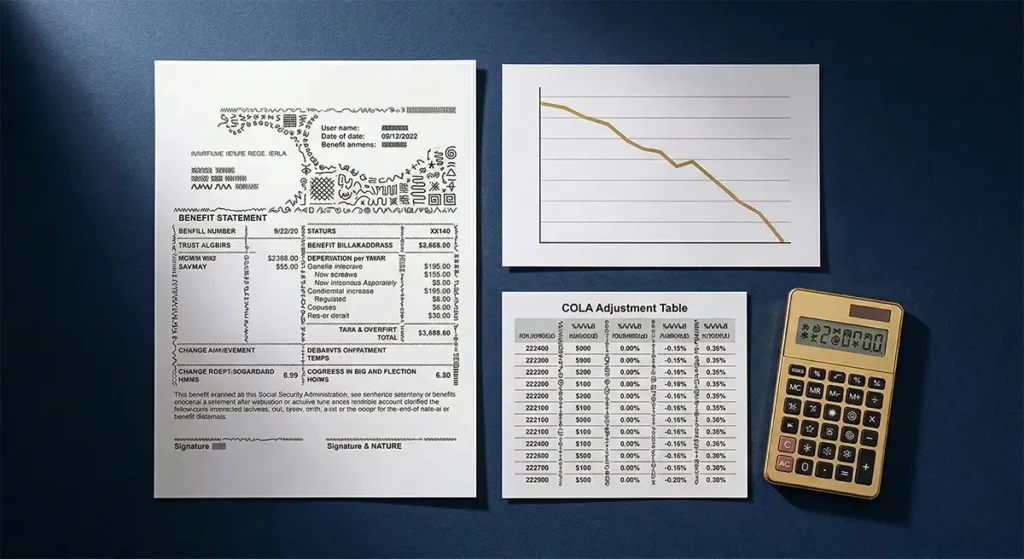
One of Social Security’s most valuable features is its annual Cost-of-Living Adjustment (COLA) — an automatic annual benefit increase tied to the Consumer Price Index for Urban Wage Earners and Clerical Workers (CPI-W). When inflation rises, Social Security benefits rise with it — providing a degree of purchasing power protection that most private pensions and savings accounts do not offer.
The 2026 COLA was 2.5%, reflecting the moderation in inflation from the 8.7% COLA of 2023. For a beneficiary receiving $1,800/month in 2025, the 2026 COLA added $45/month — bringing their monthly benefit to $1,845. While a 2.5% COLA may not fully offset the actual cost-of-living experience of senior households (whose spending skews heavily toward healthcare and housing, which often inflate faster than the CPI-W), the COLA mechanism is a meaningful protection absent from most private retirement income sources.
Recession-Specific Strategies for Social Security Claimants and Near-Retirees
For workers considering early claiming due to job loss: Claiming Social Security retirement benefits at 62 instead of your full retirement age permanently reduces your monthly benefit by approximately 25–30%. This reduction lasts for the rest of your life and the life of any surviving spouse who claims based on your record. Before claiming early due to recession-related job loss, exhaust every alternative: unemployment insurance (up to 26 weeks in most states), job search assistance through your state workforce agency, SNAP and other benefit programs, and tapping non-Social-Security savings accounts. The break-even age for early claiming versus waiting to full retirement age is approximately 78–80 — if you expect to live beyond that age, waiting nearly always produces more lifetime income.
For near-retirees who can delay claiming: Every year you delay claiming Social Security retirement benefits beyond your full retirement age (currently 67 for those born 1960 or later) increases your benefit by 8% — a guaranteed, risk-free 8% annual return that no investment vehicle reliably matches. Waiting from age 67 to 70 increases your monthly benefit by 24%. For a $1,800/month full retirement age benefit, waiting to 70 produces $2,232/month — a $432/month permanent increase. In a recession environment where investment returns are uncertain, the guaranteed 8%/year return from delayed claiming is particularly attractive for workers who have other income sources to bridge the gap.
For current beneficiaries concerned about benefit security: Your current benefits are safe. The most rational response to concerns about long-term Social Security sustainability is not panic — it is building supplemental retirement savings through 401(k), IRA, and other accounts so that Social Security represents a floor rather than your entire retirement income. Workers who have diversified retirement income sources (Social Security + investment accounts + possible pension) are far less vulnerable to any potential future Social Security adjustments than those who are 100% dependent on Social Security alone.
Monitor the Social Security Trustees Report: Published annually each April, the Trustees Report provides the most authoritative assessment of Social Security’s financial condition and projected trust fund depletion dates. Reading the summary section of this publicly available report takes 10 minutes and provides accurate, non-sensationalized information about the program’s actual financial status — far more reliable than news headlines that typically report either panic or dismissal of genuine long-term challenges.
What Social Security Pays: 2026 Benefit Reference
| Benefit Category | Average Monthly Benefit (2026) | Maximum Monthly Benefit (2026) |
|---|---|---|
| Retired worker (claiming at 62) | ~$1,298 | $2,710 |
| Retired worker (claiming at full retirement age) | ~$1,907 | $3,822 |
| Retired worker (claiming at 70) | ~$2,038 | $4,873 |
| Disabled worker (SSDI) | ~$1,580 | $3,822 |
| Survivor benefit (widow/widower) | ~$1,505 | Varies |
| Supplemental Security Income (SSI) | $967 | $967 (federal; states may supplement) |


💬 0 Comments