
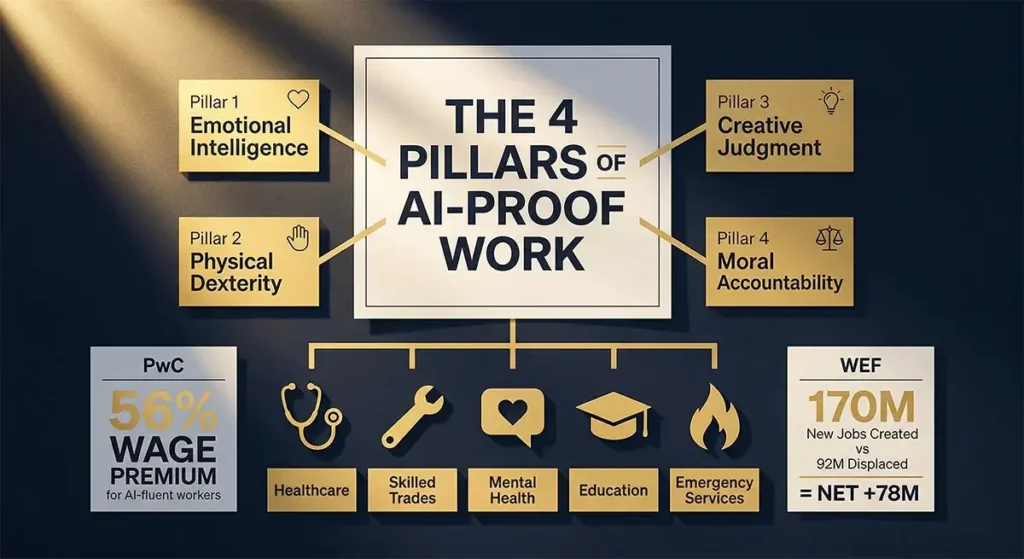
The question that dominates career planning conversations in 2026 is no longer hypothetical: “Will AI take my job?” It is a live, urgent concern for workers across industries who are watching Oracle eliminate 30,000 positions to fund AI data centers, seeing entry-level writing and coding jobs evaporate, and reading headlines about machines passing the bar exam and diagnosing cancer. The World Economic Forum’s Future of Jobs Report 2025 quantified the scale of the disruption with unprecedented precision — 92 million jobs will be displaced by AI and automation by 2030, while 170 million new roles will be created, for a net gain of 78 million jobs globally. The challenge is that those 92 million displaced workers and those 170 million new jobs are not the same people in the same locations with the same skills. The rerouting is real, and it is happening faster than most workers can navigate it.
This guide cuts through the anxiety with a data-driven answer: which jobs are genuinely AI-proof, what specific characteristics make them resistant to automation, how to evaluate your own career’s AI exposure, and — most importantly — what to do right now to protect and future-proof your professional value in a world where 39% of existing skill sets, according to the WEF, will become outdated between 2025 and 2030.
AI-proof jobs are not necessarily high-paying, prestigious, or technology-adjacent. They are jobs that depend on four characteristics AI cannot reliably replicate at human quality: genuine emotional intelligence and empathy, unpredictable physical presence in variable environments, original creative judgment with cultural and ethical context, and accountable moral and legal decision-making. The careers that check the most of these boxes — across healthcare, skilled trades, mental health, education, certain legal practice, crisis management, and complex human relationships — are the most structurally resilient to automation regardless of how rapidly AI capabilities advance.
The Honest Scale of AI’s Job Impact: What the Data Actually Shows
Before identifying the safe careers, it is worth establishing what AI is and is not doing to the job market — because both the alarmist and dismissive narratives distort the reality that workers need to navigate.
The WEF’s landmark 2025 Future of Jobs Report — drawing on surveys of over 1,000 major employers across 22 industries and 55 economies representing 14 million workers — projects 170 million new jobs created and 92 million displaced between 2025 and 2030, for a net positive of 78 million jobs. But this net positive number conceals the distribution challenge: the 92 million jobs being displaced are concentrated in specific task categories (routine data processing, repetitive customer interactions, standardized analysis), while the 170 million new jobs require skills that many displaced workers do not currently have. The WEF also found that 86% of employers expect AI to transform their business by 2030, and that 39% of existing workforce skill sets will become obsolete in the same period.
Goldman Sachs’ analysis adds complementary data: generative AI could affect up to 300 million jobs globally, but economists at the firm project only approximately a 0.5 percentage point increase in unemployment — because most affected roles will see task transformation rather than complete elimination. A 2025 MIT study estimated that currently automatable tasks represent about 11.7% of US work — significant but not the wholesale replacement that worst-case headlines suggest. Yale’s Budget Lab, after matching AI exposure scores to real employment data, found no clear economy-wide relationship so far between AI exposure and actual changes in employment or unemployment — characterizing many sweeping job-loss claims as “largely speculative” at this stage.
The honest synthesis: AI is not coming to eliminate all work. It is coming to eliminate the most routine, rules-based, digitally executable portions of work — and to restructure the remainder around human judgment, relationships, physical presence, and creativity. The workers most at risk are not those with the least education or the lowest wages — they are those whose work consists primarily of tasks that can be specified in rules, executed on a screen, and evaluated against a defined standard without human presence. The workers most protected are those whose work cannot be fully specified, cannot be executed without a body and a relationship, and cannot be evaluated without human judgment.
The Four Pillars That Make a Job AI-Proof
Research from MIT, Stanford, Oxford, and the O*NET database maintained by the US Department of Labor consistently identifies four characteristics that determine AI resistance. Understanding these pillars helps you evaluate any job — including your own — on a data-driven basis rather than intuition.
Pillar 1: Genuine Emotional Intelligence and Human Relationship Dependency. AI can simulate empathy through language — it can generate responses that sound compassionate, concerned, and supportive. What it cannot do is generate the biological trust response that humans produce in other humans through physical presence, genuine experience, shared vulnerability, and embodied care. A therapist sitting with a suicidal patient, a hospice nurse holding a dying patient’s hand, a teacher who notices that a child’s behavior change signals a family crisis — these interactions depend on a human being present in a way that no current or projected AI capability can replicate at the depth that makes the intervention effective. Jobs whose core value is delivered through the quality of human relationship — therapeutic, caregiving, teaching, coaching — are protected by a structural barrier that improving AI language models does not dissolve.
Pillar 2: Unpredictable Physical Environments Requiring Adaptive Dexterity. Robot technology has advanced significantly — but robots still cannot match the adaptive physical capability of a human body in unstructured environments. A licensed electrician can navigate a cluttered attic with unknown wiring, identify an anomaly by sight and touch, improvise a solution with available materials, and make judgment calls about code compliance in real time. A plumber can diagnose the source of a leak in a 1920s building by listening to water movement and tapping on walls. These physical problem-solving capabilities in continuously variable environments — where every job site is different, every installation has unique complications, and no two days are identical — represent a level of adaptive embodied intelligence that robotics cannot yet reliably replicate outside of highly controlled industrial settings. The skilled trades are among the most structurally AI-resistant career categories for precisely this reason.
Pillar 3: Original Creative Judgment With Cultural and Ethical Context. AI can generate content, images, music, and designs that are technically competent — sometimes breathtakingly so. What it cannot do is bring the cultural context, personal experience, ethical judgment, and genuine originality that makes creative work resonate at the level that justifies premium value. A graphic designer who understands a client’s brand history, competitive landscape, cultural audience, and unspoken identity can produce work with strategic depth that AI-generated content at scale cannot match. An architect who integrates a family’s lifestyle, site-specific environmental conditions, local building culture, and long-term maintenance reality into a design is performing creative work with an accountability dimension — the building will stand or fall on those judgments — that AI assistance supports but cannot replace. Creators who develop genuine aesthetic vision, cultural voice, and strategic judgment are protected by the premium.
Pillar 4: Accountable Moral and Legal Decision-Making. When a decision carries legal, ethical, or safety consequences — and when a specific identifiable human must bear accountability for it — AI cannot replace the human. A judge who sentences a defendant bears personal legal and moral accountability for that decision. A surgeon who makes a real-time intraoperative decision about an unexpected finding bears professional and legal accountability. A CEO who allocates capital in a way that affects thousands of employees’ livelihoods bears fiduciary and ethical accountability. A firefighter who decides whether a burning structure can be safely entered bears life-and-death accountability for the people depending on that judgment. AI can inform all of these decisions — it can provide data, analysis, precedent, and probability assessments. But the accountability structure of these roles requires a human to own the decision in a way that AI systems cannot legally or ethically be assigned.
The 15 Most AI-Proof Careers in 2026: A Complete Analysis
Healthcare — Clinical Roles
Registered Nurse (RN) and Nurse Practitioner (NP): Nurse practitioners are projected to grow 45.7% by 2032 according to the US Career Institute’s analysis of BLS data — the fastest growth rate of any occupation on the AI-resistant career list. The combination of clinical judgment, patient relationship management, physical assessment requiring touch and observation, and real-time adaptive decision-making in unpredictable patient situations makes nursing one of the most structurally AI-resistant careers available. The Resume Now AI-Resistant Careers Index 2026 — which evaluated roles on adaptability, stress tolerance, and self-control as human factors AI cannot replicate — found healthcare to dominate its top 20, with 8 of 20 positions being medical roles. Median annual wage for nurse practitioners: approximately $120,680. Entry requirement: master’s or doctoral degree in nursing.
Physical and Occupational Therapists: Physical therapists projected to grow 17% through 2032, with occupational therapists growing 12%. Both roles require hands-on patient assessment, adaptive treatment protocols that respond to daily variation in patient condition, motivational coaching that depends on human relationship, and clinical judgment about treatment progression. The physical hands-on component of these roles — which requires reading a patient’s response through touch, movement observation, and real-time feedback — is precisely the category of work that robotics cannot currently replicate at clinical quality.
Surgeons and Physicians: While AI has shown impressive capability in medical imaging interpretation and diagnostic pattern recognition, the surgeon operating in a living human body where every case is physiologically unique, where unexpected findings require immediate judgment, and where the accountability for outcomes is personal and legal, remains irreplaceable. Robotic surgery systems (da Vinci and its successors) are surgeon-controlled tools, not autonomous replacements — they extend human surgical capability rather than eliminate the surgeon. Physicians who develop specialized expertise in areas requiring complex patient interaction, rare disease management, or integrative care coordination are least exposed to AI displacement.
Mental Health and Social Services
Licensed Mental Health Counselors, Therapists, and Social Workers: Mental health counseling represents one of the most AI-proof career categories available in 2026. The therapeutic relationship — the specific, research-validated mechanism through which therapy produces outcomes — depends on human presence, genuine empathy, cultural understanding, and the trust that comes from one human believing another human understands their experience. AI chatbots and digital mental health tools have expanded access to support but have not produced outcomes comparable to human therapy for moderate to severe mental health conditions. As mental health awareness has grown and access has expanded, demand for qualified human mental health professionals has increased rather than decreased despite the proliferation of digital alternatives. School counselors alone project to grow 13% through 2026, driven by rising enrollment and heightened focus on student mental health.
Licensed Skilled Trades
Licensed Electricians, Plumbers, HVAC Technicians: The licensed skilled trades represent what may be the single most undervalued AI-proof career category available to workers who do not want a four-year college credential. Licensing requirements, multi-year apprenticeship programs, and the inherently variable physical nature of trade work create both structural protection from automation and persistent supply constraints that maintain strong wages across economic cycles. A journeyman electrician in 2026 earns $35–$55/hour in most US markets, with licensed contractors earning significantly more. AI cannot wire a building, install a heating system, or diagnose a plumbing failure in a 50-year-old home where the original installation did not follow current code and where every access point presents a different physical challenge.
Education and Training
K-12 Teachers, Special Education Instructors, Early Childhood Educators: AI can explain topics, generate lesson content, and adapt presentation to individual learning styles with impressive capability. What it cannot do is create the classroom community, notice that a student’s behavior has changed because of a family situation, build the motivational relationship that makes a struggling student believe they can succeed, manage the social dynamics of 25 children in a physical space, or provide the embodied human presence that child development research consistently identifies as essential to cognitive and social-emotional development in early childhood. Special education roles — which require individualized instruction, adaptive communication, behavioral understanding, and family relationship management — are among the most AI-resistant educational positions. They are also among the most persistently understaffed, with job security reflecting genuine structural demand.
Emergency and Public Safety
Firefighters, Emergency Medical Technicians (EMTs), Paramedics: Emergency response in uncontrolled physical environments requiring immediate adaptive action, physical strength and dexterity, real-time medical judgment, and direct human rescue is structurally incompatible with current robotic and AI capabilities. The combination of physical danger, environmental unpredictability (no two structure fires are the same), and the life-safety accountability of the role — where incorrect decisions have immediate irreversible consequences — makes emergency services among the most fundamentally human careers available. These roles also benefit from public sector employment stability that provides recession resistance alongside AI resistance.
Legal and Compliance
Trial Attorneys and Complex Litigation Specialists: AI has demonstrated significant capability in legal research, document review, contract analysis, and even argument drafting — disrupting significant portions of legal associate work. But courtroom advocacy, the development of case strategy based on deep client relationship and full case context, jury selection psychology, witness examination, and the judgment calls of a trial that develop in real time as evidence unfolds — these remain deeply human practices. Lawyers who specialize in trial advocacy, complex negotiation, and the human relationship dimensions of legal practice (family law, criminal defense, immigration) rather than in research and document production are significantly more AI-resistant than those in document-heavy transactional roles. Even in a world where AI handles 80% of legal research tasks, the 20% that requires human courtroom performance and accountability remains the core value of legal practice.
Mental Health, Counseling, and Coaching
Life and Executive Coaches, Career Counselors: The coaching relationship — in which a skilled coach helps a client develop insight, accountability, and behavioral change through structured conversation and relationship — produces outcomes through human trust and accountability dynamics that AI interactions have not replicated. An executive coach who works with a C-suite leader over 12–18 months builds organizational context, personal history, behavioral pattern recognition, and accountability relationship that AI cannot substitute. The premium for this human relationship has increased, not decreased, as AI has made generic advice more available — because the contrast between widely available automated guidance and bespoke human accountability has become more visible.
Creative Direction and Strategic Brand Communication
Creative Directors, Brand Strategists, Senior UX Designers: AI has democratized creative production — anyone can now generate competent visual content, write serviceable copy, and produce functional user interface designs with AI tools. This commoditization of production is reducing demand for entry-level execution roles while simultaneously increasing demand for senior creative judgment — the ability to evaluate what AI produces, make strategic decisions about creative direction, and bring original cultural insight that differentiates a brand from its AI-assisted competitors. Creative professionals who develop genuine aesthetic vision and strategic brand understanding, and who learn to direct AI production rather than compete with it, positions in the most valuable position in the creative market: human intelligence plus AI output scale.
Jobs Most Vulnerable to AI Displacement: The Honest Warning
For the sake of completeness, and because understanding risk is essential to making informed career decisions, the job categories with the highest AI displacement exposure in 2026 share a consistent profile: the work is primarily rule-based, digitally executable, and evaluable against defined standards without human presence.
The most vulnerable categories include: data entry clerks and administrative processors (routine information transformation that AI executes at greater speed and lower cost), basic customer service representatives handling standardized inquiries (already significantly automated through chatbots and IVR systems with continued automation likely), telemarketers and cold-call salespeople (automated outreach tools have already dramatically reduced headcount in this category), paralegals performing document review and basic legal research (AI legal research tools have reduced junior attorney and paralegal hours per case significantly), basic bookkeeping and accounts payable/receivable processing (accounting software with AI integration is automating the transaction entry and reconciliation work that defined entry-level accounting roles), and entry-level content writing for standardized formats (product descriptions, basic news summaries, template-driven content).
The critical nuance: even in these vulnerable categories, the highest-level human roles — the manager who evaluates the AI’s output, makes judgment calls about exceptions, and manages the client relationship — remain human. AI is eliminating the entry-level execution layer while preserving and often expanding the senior judgment layer. Workers in vulnerable categories face a narrowing pathway rather than a closed door — but the pathway requires moving toward judgment, relationship, and accountability rather than deeper execution specialization.
The PwC AI Premium: What Embracing AI Does to Your Earnings
The most actionable data point for workers navigating the AI transition comes from PwC research showing a 56% wage premium for workers who use AI effectively in their roles. McKinsey’s analysis found that skill demands are shifting 66% faster in AI-exposed roles than in other roles — creating a rapidly expanding premium for workers who can bridge their domain expertise with AI capability. This is the most important career strategy insight available in 2026: the workers who displace are those who compete with AI at its strengths (speed, scale, pattern recognition on structured data). The workers who will command premium compensation are those who use AI at its strengths to amplify their human capabilities — emotional intelligence, physical judgment, creative direction, and ethical accountability that AI cannot replicate.
How to Evaluate Your Own Job’s AI Exposure Right Now
Before panicking about AI or dismissing the concern, conduct a specific task audit of your actual work. List 15–20 specific tasks you perform in a typical week. For each task, honestly categorize it: (A) Routine and digital — rules-based, screen-executable, evaluable against a defined standard; (B) Judgment and relational — requires contextual reasoning, human relationship, or evaluative discretion; or (C) Physical and embodied — requires human presence in a physical environment.
If 70% or more of your tasks are Category A, your role has meaningful AI exposure and warrants proactive career planning now — not when the displacement actually occurs, when your options are narrower. If your work is primarily Categories B and C, you are in structurally AI-resistant territory — your priority is developing AI fluency to use these tools productively rather than worrying about replacement. The workers who will thrive are those who conduct this audit honestly, develop Category B and C capabilities proactively, and learn to direct AI execution of their Category A tasks rather than competing with AI in performing them.
The Career Action Plan: Protecting Yourself in the AI Era
Deepen human skills deliberately: Emotional intelligence, conflict resolution, difficult conversation management, and leadership presence are skills that develop through practice, coaching, and deliberate experience — and they become more valuable as AI commoditizes analytical and production work. Invest in developing these skills as actively as you invest in technical skills.
Develop AI tool fluency in your specific domain: Every profession has AI tools emerging to assist it. Healthcare workers using AI diagnostic assistance, lawyers using AI research tools, teachers using AI content generation and personalization tools — all are more productive and more valuable than equivalents who resist these tools. AI fluency within your domain is the career insurance policy that protects against displacement by making you the human who directs the AI rather than the human who competes with it.
Move toward accountability and relationship: In any role, the tasks with the highest AI resistance are those where you own the outcome, manage the relationship, and make the judgment calls. Volunteer for responsibilities that put you in direct contact with clients, patients, students, or stakeholders. Build the organizational relationships that make you known as the person who trusts with judgment-dependent decisions.
Consider the AI-proof career categories if you are early in your career path: If you are at a career choice point, the data in this guide is directly actionable: healthcare clinical roles, licensed skilled trades, mental health professions, and education offer strong structural AI resistance with solid long-term wage trajectories and genuine social value. The stigma that some of these careers carry — that skilled trades are “less prestigious” than office work, or that teaching is “underpaid compared to tech” — is a relic of a labor market structure that AI is actively dismantling.



💬 0 Comments