
The average American paid $48,644 for a new vehicle in 2024 — and 2026 tariffs on imported vehicles and auto parts have pushed that figure even higher for many models. Yet the vast majority of American car buyers negotiate poorly or not at all, paying thousands more than necessary. This guide gives you the complete framework to negotiate the best possible price on any vehicle in 2026.
The average car buyer who negotiates effectively saves $2,000–$5,000 on a new vehicle purchase compared to buyers who accept the first offer. The negotiation leverage entirely favors buyers who do their research, are willing to walk away, and separate the vehicle price negotiation from the financing and trade-in negotiation — the three transactions dealers most want to blend together.
The 2026 Car Market: What You Need to Know
The 2026 automotive market is shaped by three forces. First, the 25% tariff on imported vehicles (implemented April 2025) has raised the effective price of many imported models — Japanese, Korean, European, and Mexican-assembled vehicles. Second, new vehicle inventory has normalized from the 2021–2023 shortage era, when dealers sold cars above MSRP. In 2026, most dealers carry 45–75 days of inventory — a buyer’s market for most models. Third, high interest rates continue to elevate monthly payment costs, making financing a critical dimension of the negotiation. Check Edmunds, Kelley Blue Book, and TrueCar for actual transaction prices in your region before visiting any dealership.
Step 1: Secure Your Own Financing Before You Walk In
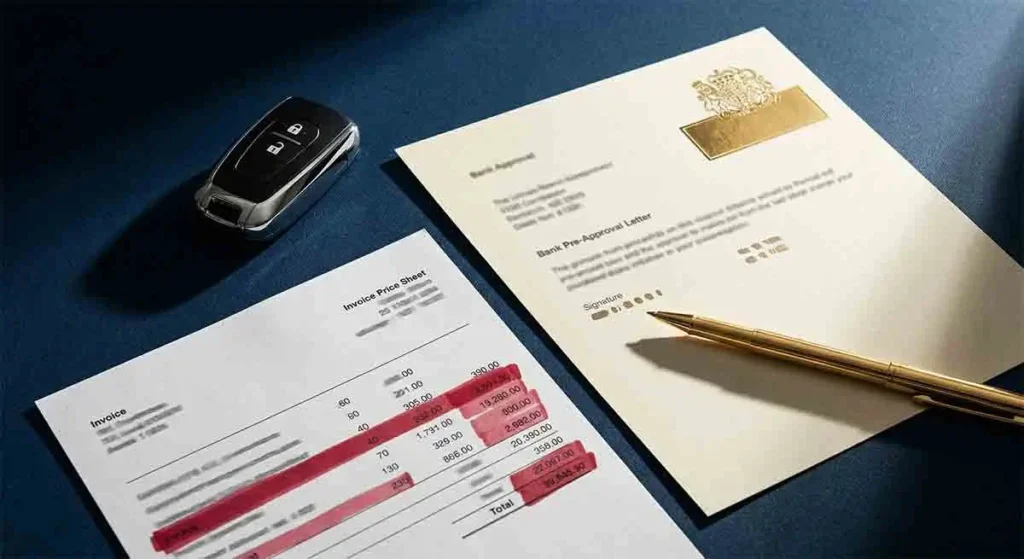
The single most powerful preparation step is obtaining a pre-approved auto loan from a bank or credit union before visiting any dealership. This removes the dealer’s most powerful closing tool: the ability to confuse the vehicle price negotiation with the monthly payment calculation. Where to get pre-approved: your primary bank, your credit union (typically the lowest auto loan rates — federal credit union rates are capped at 18% APR by law), and online lenders including LightStream, PenFed Credit Union, and Consumers Credit Union. Compare at least 3 offers before choosing.
Step 2: Research the Dealer’s True Cost
MSRP is the starting point for negotiation — not a fair price to pay. The dealer’s actual cost is lower through three components: Invoice price (published at Edmunds and KBB — typically $500–$3,000 below MSRP depending on vehicle), Holdback (2–3% of MSRP rebated to the dealer by the manufacturer after the vehicle sells — meaning dealers can profitably sell at or below invoice), and Dealer incentives (manufacturer cash bonuses for volume and specific model targets, highest at end of month, end of quarter, and end of model year). Your target negotiating price: invoice price minus customer cash rebates, plus a reasonable dealer profit of $300–$600.
Step 3: Negotiate the Selling Price First
The cardinal rule: separate the vehicle price from the trade-in value and from the financing terms. When the salesperson asks “what monthly payment are you looking to hit?” — this is the signal they are preparing to manage you through monthly payment rather than through vehicle price. Your correct response: “I want to agree on the out-the-door price of the vehicle first. What is your best price on this vehicle today?” Make your first offer below your target to create negotiating room. If the dealer refuses to move below MSRP and your research shows the vehicle selling below MSRP in your market, say: “I have dealer quotes in the region at X — can you match that?”
Step 4: Negotiate the Trade-In Separately
After agreeing on the vehicle price, introduce your trade-in as a completely separate transaction. Get appraisals from CarMax, Carvana, and your local dealer before the negotiation — these create a verified baseline you can reference. Selling your vehicle privately through Facebook Marketplace or Craigslist typically produces 15–25% more than any dealer trade-in offer, though it requires more time and logistical complexity.
Step 5: Navigate the Finance and Insurance Office
The F&I office staffs the most highly trained negotiators in the dealership. Honest assessments of common F&I products: Extended warranties are significantly overpriced at dealerships — the same coverage from Endurance, CARCHEX, or the manufacturer directly costs 40–60% less (you have 30–60 days after purchase to add coverage). GAP insurance is worthwhile for high-financing-ratio purchases but available from your auto insurer at 60–80% less than the dealer’s price. Paint protection, fabric protection, and nitrogen tire fill are almost universally overpriced add-ons — decline all of these. Compare the dealer’s financing offer directly to your pre-approved loan rate — only accept dealer financing if it genuinely beats your pre-approval rate.
Best Timing to Buy for Maximum Leverage
Best days: Monday through Wednesday — dealers are less busy and more motivated. Weeks: Last week of the month and last quarter-end. Best months: December (model year clearance), October-November (new models arriving, prior year discounted), and January (slowest sales month). 2026-specific advantage: Recession fears are suppressing consumer spending, meaning dealers are more motivated to negotiate than at any point since before the 2021–2023 inventory shortage. Buyer leverage is at its highest in several years.



💬 0 Comments