
The decision of whether to rent or buy a home is one of the most consequential financial choices most Americans make — and in 2026, it is also one of the most genuinely difficult, with elevated mortgage rates, high home prices, softening rents in some markets, and recession uncertainty creating a uniquely complex environment. This guide provides the complete analytical framework to make the rent vs buy decision correctly for your specific situation — without the bias toward buying that pervades most real estate industry advice.
The rent vs buy decision is not about which is universally better — it is about which is better for your specific situation at this specific time. Buying is financially superior when you plan to stay for 5+ years, have a stable income, and can afford to buy without stretching your finances dangerously thin. Renting is superior when you have a shorter time horizon, uncertain income, high debt, or when the total cost of ownership in your market significantly exceeds rent for comparable housing.
The True Cost of Homeownership: What the Mortgage Payment Misses
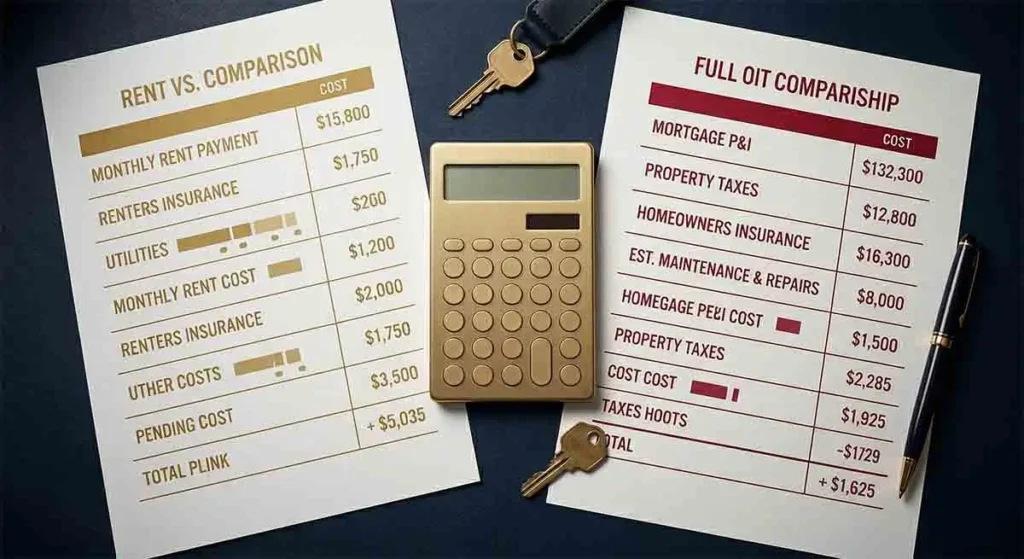
The most common mistake buyers make is comparing a mortgage payment to a rent payment as if they are equivalent costs. They are not. The full monthly cost of homeownership includes the mortgage principal and interest payment, property taxes (national average approximately 1.1% of home value annually — $458/month on a $500,000 home), homeowner’s insurance ($125–$200/month for most single-family homes), private mortgage insurance or PMI (required when down payment is below 20% — typically 0.5–1.5% of the loan amount annually), HOA fees if applicable ($200–$800/month in many communities), and maintenance and repair costs (the standard financial planning estimate is 1–2% of the home’s value per year — $5,000–$10,000/year on a $500,000 home).
On a $500,000 home with a 20% down payment ($100,000) and a 6.75% 30-year mortgage in 2026, the monthly payment breakdown looks like this:
| Cost Component | Monthly Amount | Annual Amount |
|---|---|---|
| Principal & Interest (6.75%, 30yr, $400K loan) | $2,594 | $31,128 |
| Property Tax (1.1% of $500K) | $458 | $5,500 |
| Homeowner’s Insurance | $150 | $1,800 |
| Maintenance Reserve (1.5% of $500K) | $625 | $7,500 |
| Total True Monthly Cost | $3,827 | $45,928 |
A comparable rental unit in the same market may rent for $2,800–$3,200/month — appearing cheaper on a simple monthly comparison. But the calculation is more complex because homeownership builds equity, provides tax deductions, and offers protection from rent increases. The break-even analysis below provides the complete picture.
The Price-to-Rent Ratio: A Quick Market-Level Signal
The price-to-rent ratio divides the median home price in a market by the annual cost of renting a comparable property. A lower ratio favors buying; a higher ratio favors renting.
| Price-to-Rent Ratio | General Indication |
|---|---|
| Below 15 | Strongly favors buying — market is relatively inexpensive to own |
| 15–20 | Neutral zone — decision depends on individual circumstances |
| Above 20 | Favors renting — home prices are high relative to rental costs |
| Above 25 | Strongly favors renting — market significantly overvalued relative to rents |
In 2026, major coastal markets including San Francisco (ratio ~28), Los Angeles (~24), New York City (~22), Seattle (~22), and Boston (~21) strongly favor renting on a pure financial calculation. Midwestern and Southern markets including Detroit (~10), Cleveland (~11), Memphis (~12), Indianapolis (~13), and Columbus (~14) favor buying. Markets including Atlanta (~17), Dallas (~18), and Phoenix (~19) sit in the neutral zone where individual circumstances dominate the decision.
Calculate your local price-to-rent ratio: find the median home price in your target neighborhood on Zillow, divide by the annual rent for a comparable property (monthly rent × 12). The resulting number tells you where your specific target market sits on the spectrum.
The Break-Even Horizon: How Long You Must Stay to Make Buying Worth It
The break-even horizon is the number of years you must stay in a home before buying becomes financially superior to renting — accounting for transaction costs, early mortgage interest (mostly interest, not equity-building, in the early years), and the opportunity cost of the down payment. In most US markets in 2026, the break-even horizon ranges from 4–8 years depending on:
Transaction costs on both entry and exit are substantial. Buying costs: closing costs typically 2–4% of the purchase price ($10,000–$20,000 on a $500,000 home — paid entirely at closing, generating zero equity). Selling costs: real estate agent commissions (3–5% of sale price in 2026, though buyer’s agent commission structures are changing post-NAR settlement), title transfer taxes, and closing costs consume 6–10% of the sale price. On a $500,000 home, transaction costs alone — ignoring all other factors — represent $40,000–$60,000 that must be recovered through appreciation or equity building before you break even financially on the purchase.
The general rule: If you are confident you will stay in the home for 5+ years, the break-even math typically works in favor of buying in markets where the price-to-rent ratio is below 20. If your time horizon is under 4 years, renting is almost always financially superior regardless of market conditions — the transaction costs of buying and selling within a short period rarely allow recovery.
The 2026-Specific Factors Affecting the Decision
Elevated mortgage rates: The 30-year fixed mortgage rate in early 2026 sits at approximately 6.5–7.0% — more than double the historic lows of 2021 (2.65%). At these rates, the monthly payment on a $400,000 mortgage is approximately $2,528–$2,661 — versus $1,686 at the 2021 low rate. This elevated monthly cost pushes break-even timelines longer and makes renting more competitive in many markets than it was 2–3 years ago.
The “lock-in effect” on existing homeowners: Approximately 60% of outstanding US mortgages have interest rates below 4% — homeowners who refinanced during 2020–2021. These homeowners are extremely reluctant to sell and take on a new 6.5–7% mortgage, creating reduced inventory in most markets and keeping home prices elevated despite reduced buyer demand. This supply constraint means buyers face high prices without the softening that typically accompanies demand reduction.
Rental market softening: New apartment construction completions in 2024–2025 have added significant rental supply in many Sun Belt and suburban markets — Austin, Phoenix, Nashville, Charlotte, and others. This new supply is pushing rents down or holding them flat in these markets, improving the relative value of renting compared to buying.
Recession uncertainty: In a period of recession risk, the flexibility of renting — the ability to relocate for a new job, downsize quickly if income drops, or move to a lower-cost-of-living market — has genuine economic value that is difficult to quantify but very real. A homeowner who loses their job faces a mortgage payment regardless; a renter can give 30–60 days notice and move.
The Non-Financial Factors: Why People Buy Even When Renting Is Cheaper
Not every housing decision is purely financial — and there are legitimate non-financial reasons to buy even when renting may be marginally cheaper on a pure cash-flow basis. Stability and permanence — the ability to paint, renovate, get a dog, plant a garden, and not worry about lease renewals or rent increases — has genuine quality-of-life value. School district stability for children is particularly important for families. The forced savings aspect of building equity through mortgage payments creates wealth for people who are not disciplined savers. And the emotional satisfaction of homeownership — owning your space, building roots in a community — has value that spreadsheets do not capture.
The important caveat: these non-financial benefits only justify homeownership when the financial decision is at least close — when you are staying long enough, in a reasonably priced market, with a stable enough income to make the financial reality manageable. Buying a home beyond your financial means in pursuit of non-financial benefits has destroyed more American household wealth than almost any other single financial decision.
The Down Payment Question: 20% vs Less
The traditional recommendation of a 20% down payment exists because it eliminates PMI, produces a lower monthly payment, demonstrates financial stability, and provides immediate equity buffer against price declines. In 2026, on a $400,000 median-priced home, 20% down is $80,000 — a barrier that takes many households years to accumulate and may represent an opportunity cost (the same $80,000 invested in a diversified stock portfolio has historically returned 7–10% annually over long periods).
Lower down payment options exist: FHA loans (3.5% down with credit scores 580+, 10% down with scores 500–579), conventional loans with 3–5% down through Fannie Mae HomeReady and Freddie Mac Home Possible programs, VA loans for military personnel and veterans (0% down), and USDA loans for rural properties (0% down). The tradeoff: lower down payments mean higher monthly payments, PMI, less equity protection, and often a higher total cost of homeownership. Down payment assistance programs from state housing finance agencies provide grants or low-interest secondary loans to first-time buyers in most states — worth investigating before assuming you must save 20%.


💬 0 Comments